

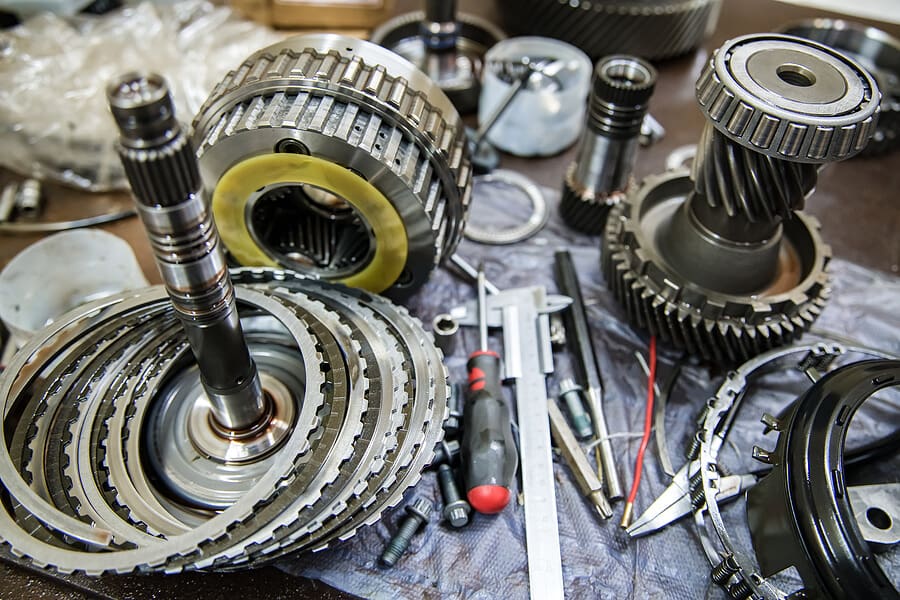
Torque converter shudder can feel like a brief vibration or like driving over rumble strips, often while the vehicle is under light or steady throttle. But that description is not a diagnosis. Engine combustion problems, transmission-control faults, tires and driveline vibration can create a similar complaint.
The useful question is not simply, “Did it shake?” It is, “What was the engine, transmission and torque-converter clutch doing at the exact moment it shook?”
What does torque converter shudder feel like?
Some drivers describe a felt vibration, rough-pavement sensation or engine-misfire-like shake. General Motors used those complaint descriptions in application-limited bulletins for certain vehicles, including 2012 Cadillac CTS and Chevrolet Camaro models with specified engines and 6L45/6L50 transmissions, and listed 2016–2020 Chevrolet and GMC vehicles with specified 6L transmissions.
Those documents do not establish one universal speed, throttle position or feel for every automatic transmission. They show that “rumble strips” is a useful way to describe a complaint to a technician, not proof that the converter has failed.
Record the conditions without deliberately recreating them:
- the approximate road speed and selected gear, if displayed;
- whether the throttle was steady, increasing or released;
- whether the transmission was shifting or already in a gear;
- whether the vehicle and transmission were cold or fully warmed;
- whether the vibration appeared during cruising, a grade, towing or another load condition;
- whether engine speed changed on the tachometer;
- any warning light, message or stored diagnostic report; and
- whether the sensation stopped when traffic, throttle or road conditions changed naturally.
Consumers should not perform a brake-and-throttle test or use a scan tool to command the converter clutch. OEM diagnostic procedures are written for trained technicians using the specified equipment and a controlled test plan.
What is actually shuddering?
An automatic transmission’s torque converter transfers engine torque into the transmission. Under selected operating conditions, its torque converter clutch can be commanded to control slip or create a more direct connection.
GM bulletin PIP5504E defines torque-converter shudder or vibration as a vibration induced by the torque converter clutch during normal driving with an expected amount of clutch slip. That definition matters because it ties the label to clutch operation. A vibration that happens at the same road speed regardless of clutch state, or one that follows unstable engine torque, may need a different diagnosis.
The clutch can therefore be part of the event without the words “bad converter” being justified from the driver’s seat. The technician still has to determine whether the disturbance tracks with commanded clutch behavior and whether the cause is fluid condition, converter hardware, control behavior or something outside the converter.
Why the sensation alone is not enough
The strongest reason to resist a feel-only diagnosis comes from OEM guidance itself.
GM bulletin 22-NA-015 covers specific 2020–2022 Cadillac, Chevrolet and GMC applications with listed engines and transmissions. It separates engine-related shudder, valve-body or solenoid behavior, converter-clutch shudder and a normal Dynamic Fuel Management characteristic by comparing engine speed, engine torque, transmission input speed, throttle and clutch data.
The bulletin also warns that vehicles receiving a converter for a shudder complaint often return for additional engine or transmission work and says that, in most of the warranty claims it reviewed, the converter was not the cause. That is an application-limited warranty-review finding, not a failure-rate estimate for every vehicle. Its broader lesson is sound: confirm the event before replacing the expensive part.
PIP5504E makes a similar distinction for its listed 2016–2020 GM applications. It tells technicians to determine whether the vibration tracks with engine speed, road speed or converter-clutch behavior and to address known tire, brake or other vibration inputs before the converter test.
What can mimic torque converter shudder?
The table below is a question map, not a remote diagnostic chart.
| Possible source or condition | Evidence a technician may compare | Why feel alone cannot decide |
|---|---|---|
| Torque converter clutch event | Commanded and actual TCC slip, gear, throttle, engine speed and transmission input speed during the complaint | A similar vibration can occur while another system is changing |
| Engine combustion or misfire | Engine torque and speed behavior, misfire data, diagnostic trouble codes and whether the event follows engine operation | A driver may describe both as a misfire-like shake |
| Valve-body or TCC-solenoid control | TCC pressure/control data, selected range, gear and application-specific bulletin criteria | The clutch may be reacting to a control problem rather than failed converter hardware |
| Tire or wheel vibration | Relationship to road speed, tire/wheel condition and whether the vibration remains with TCC state changes | Road-speed vibration can be felt through the same seat, floor or steering column |
| Driveshaft, axle or joint disturbance | Relationship to road speed, load, gear and driveline inspection findings | Load-sensitive vibration is not exclusive to a converter |
| Rear-axle geometry | Ride height, pinion angle and application-specific inspection results | Ford routes a bounded Ranger acceleration shudder to rear-axle geometry, not the converter |
| Normal powertrain characteristic | Exact vehicle calibration, operating mode, like-vehicle comparison and OEM service information | Some application-specific operating transitions can be felt without a failed part |
| Transmission shift event | Commanded gear, shift timing, input/output data and whether the event occurs during or outside a shift | A shift complaint and a steady-state clutch event require different evidence |
This list is not exhaustive and does not assign a repair. It shows why a useful diagnosis synchronizes the driver’s complaint with actual operating data.
How does a shop confirm or reject TCC shudder?
A disciplined diagnosis begins by defining the complaint and checking whether current service information applies to the exact VIN, engine, transmission and calibration. The technician can then decide which data and test conditions are appropriate.
Application-limited GM procedures illustrate the evidence categories:
- Complaint conditions: speed, load, throttle, gear, shift state and fluid temperature when the event occurs.
- Diagnostic trouble codes: engine and transmission codes are addressed before the road-test conclusion.
- Synchronized data: engine speed, engine torque, transmission input speed, actual/commanded TCC slip and control pressure are compared at the disturbance.
- Vibration relationship: the technician checks whether the frequency follows the engine, tire/road speed, driveshaft or the converter-clutch event.
- Fluid and debris condition: exact OEM procedures can distinguish a fluid-service branch from signs requiring deeper transmission inspection.
- Application-specific result: software, fluid service, valve-body work, converter replacement or investigation outside the transmission may be different branches for different vehicles.
GM PI0700B, limited to specified 2012 CTS and Camaro applications, instructs technicians to monitor TCC slip and compare the complaint with the clutch commanded off and on. If the concern remains when clutch state no longer supports a converter-shudder conclusion, the bulletin says converter replacement will not correct it. That is a professional diagnostic example, not a consumer test procedure or a rule for other vehicles.
Does a transmission code prove the converter is bad?
No single generic statement about a code can replace the application-specific diagnostic path. GM’s current examples tell technicians to check and resolve relevant engine and transmission codes, but they also require complaint reproduction and synchronized operating data.
A code can identify a circuit, performance threshold or monitored condition. It does not automatically prove which internal component caused the condition, and the absence of a warning light does not make a felt vibration self-diagnosing. Ask for the exact code, freeze-frame or session data and the test that connects it to the recommended repair.
Will changing the fluid fix torque converter shudder?
Sometimes an OEM procedure assigns a fluid-service branch after the condition is confirmed. That does not make a universal “flush it first” rule.
GM bulletin 23-NA-072 covers specified 2019–2025 Buick, Cadillac, Chevrolet and GMC models with particular 9-speed transmissions. It separates normal, degraded and damaged conditions using scan data and a fluid-condition check. Its degraded branch calls for the specified drain and refill; its damaged branch can call for converter replacement. It also says not to proceed with fluid inspection/change or converter replacement when the observed shudder or slip-control result is normal.
GM bulletin 18-NA-091 takes a different path for specified 2018 Buick Enclave and Chevrolet Traverse applications: after confirmation, it calls for updated transmission-control software, Service Fast Learn and the specified DEXRON VI drain and refill. PIP5504E separately identifies DEXRON VI as the approved fluid for the listed GM 6L transmissions.
Honda bulletin 18-017 shows why even the word “flush” needs a precise definition. For its VIN-limited 2012 and specified 2013 Odyssey Touring/Touring Elite application after the relevant software path, Honda says the admitted judder is commonly mistaken for a bad converter but attributes the confirmed condition to deteriorated ATF. It requires software-status review and an automatic-transmission data snapshot before its repeated drain-and-fill procedure with Honda ATF-DW-1. That is not permission to apply the same diagnosis, fluid or method to another Odyssey or transmission.
Toyota bulletin T-SB-0034-14 Rev2 reaches a materially different result for certain pre-breakpoint 2012–2014 Camry vehicles with the specified U760/U760E application. Its branch combines torque-converter replacement with exact ATF handling and ECM/PCM calibration work. If the described condition is not present, Toyota directs normal repair-manual diagnosis instead. This is another bounded example, not a converter-first rule.
Together, these examples establish three boundaries:
- confirm the condition before choosing a repair branch;
- use the exact fluid specification and procedure for the vehicle; and
- do not turn one OEM bulletin into a universal cure for another transmission.
This article does not recommend an additive, a flush machine, a drain-and-fill interval or a fluid type for an unidentified vehicle. An estimate should name the fluid specification, quantity, service method, software or relearn steps, and evidence supporting that branch.
Does shudder mean the whole transmission needs replacement?
Not automatically. The evidence may point outside the transmission, to a control component, to fluid degradation, to converter hardware or to a larger internal transmission problem. The correct scope depends on the exact unit and findings.
Compare any estimate with these questions:
| Estimate field | What the written recommendation should identify |
|---|---|
| Exact vehicle and transmission | VIN, engine, transmission code/RPO or other application identifier |
| Confirmed complaint | Speed, throttle, gear, temperature and shift state where it occurred |
| Codes and data | Relevant DTCs plus the scan or vibration evidence connecting the event to the repair |
| Fluid condition | Correct specification, level/condition findings, contamination or debris observations |
| Proposed repair branch | Software/relearn, fluid service, control/valve-body work, converter, internal transmission or non-transmission repair |
| Converter-only versus unit replacement | Why the smaller or larger scope fits the findings and current service information |
| Related cooler or filter work | Exact procedure and why it is included |
| Conditional findings | What would change the scope, who approves it and when work stops |
| Warranty | Whose warranty applies, exact term and covered part/labor |
A transmission replacement recommendation should not be inferred from the word “shudder.” A low-priced fluid service should not be sold as a guaranteed cure either. The evidence has to support the branch.
Is it safe to keep driving with a shudder?
This article cannot determine that remotely. “Shudder” is a description shared by conditions with different consequences, and the vehicle’s warning messages and owner information control immediate instructions.
The 2012 Cadillac CTS/CTS-V owner manual illustrates that message-specific boundary. It gives one response to SERVICE TRANSMISSION and a different, immediate stop-and-idle instruction for TRANSMISSION HOT IDLE ENGINE. Those words and actions apply to that manual, not every vehicle. They show why the exact dashboard message and the correct owner manual outrank generic internet advice.
Do not deliberately reproduce the event to collect better notes, and do not treat the absence of a warning as proof that continued driving is safe. Follow the exact vehicle warning and owner-manual instruction. If the behavior makes the vehicle difficult to control or you cannot reconcile the warning with the manual, arrange vehicle-specific help rather than relying on a mileage allowance from this article. Contact a qualified shop for vehicle-specific guidance about whether it should be driven or transported; the complaint alone does not answer that question.
What to bring to the diagnostic appointment
The best owner contribution is a precise history, not a diagnosis:
- VIN, mileage and any transmission identification already documented;
- when the issue began and whether it is changing;
- approximate speed, gear, throttle and temperature conditions;
- whether it happens during a shift, after a shift or at steady speed;
- dashboard warnings and exact code printouts, if another shop supplied them;
- recent battery, engine, transmission, tire or driveline work;
- transmission-fluid service history, fluid used and invoice details;
- towing, payload or overheating context without deliberately recreating it; and
- a short recording only if a passenger captured it safely.
That record lets the technician reproduce the complaint under an appropriate plan and compare it with the right data. It also reduces the chance that a normal condition or a different vibration is mislabeled from memory.
The practical answer
Torque converter shudder is a converter-clutch-related vibration confirmed by how the event lines up with clutch command and slip—not by the “rumble strip” description alone. The exact vehicle, operating conditions, engine/transmission data and fluid findings decide whether the next step involves software, fluid, a control component, the converter, a larger transmission repair or another system entirely.
For a Rowlett-area vehicle, Accelerate’s engine and transmission diagnosis and repair service is the existing local owner. That service link is not proof that a particular shudder comes from the converter or that every OEM bulletin procedure is offered.