

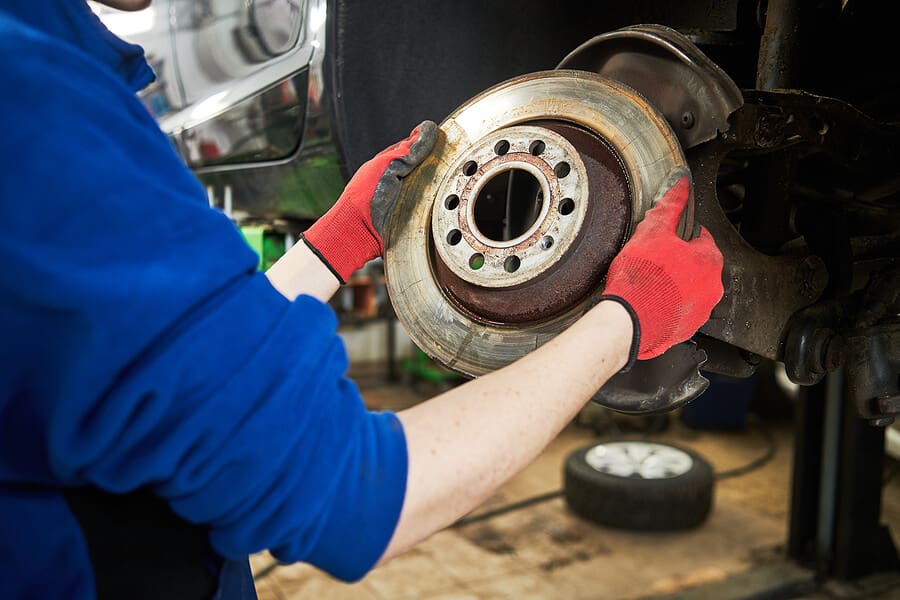
A brake pad replacement on one axle typically runs $335 to $394, according to RepairPal’s national estimator, last updated September 3, 2026, with labor priced between $122 and $179 and parts between $213 and $215. RepairPal’s own description of the job notes that "brake pad replacement is done in pairs," meaning both front wheels or both rear wheels at once, or all four. The estimate covers one axle’s pair of pads, not a whole-vehicle four-wheel job, though RepairPal’s page does not use the words "per axle" explicitly. If your quote also lists new rotors, expect the number to climb toward RepairPal’s separate rotor-replacement range of $574 to $698. If it lists a caliper, RepairPal’s caliper estimate runs $898 to $968. Before you approve anything, get clear on which of those three jobs you’re actually being quoted for.
Pads only, pads and rotors, or calipers: what each one adds
These are three different jobs, and a shop should tell you which one it’s quoting. RepairPal prices each separately:
| Job | RepairPal national range | Labor | Parts |
|---|---|---|---|
| Brake pad replacement (pads only, one axle) | $335 – $394 | $122 – $179 | $213 – $215 |
| Brake rotor replacement | $574 – $698 | $168 – $247 | $406 – $452 |
| Brake caliper replacement | $898 – $968 | $150 – $219 | ~$749 |
Pads-only is the smallest of the three jobs and the one most brake quotes should start as, unless the rotors or calipers are actually damaged. RepairPal’s brake pad process description covers replacing worn pads and inspecting rotors, "resurface or replace as necessary," not replacing rotors by default.
Adding rotors is common, and RepairPal explains why: "brake pads show wear patterns after many times of grinding into the old brake rotor, and must be replaced to avoid brake noise" whenever new rotors go on, since a fresh rotor against old, unevenly worn pads won’t seat correctly.
Calipers are the biggest and least common of the three. A caliper only gets replaced when it’s actually damaged (seized, leaking, or sticking), not as routine maintenance. When one is, RepairPal’s process notes that the brake "pads (and rotors, if needed) on the opposite side must be replaced, as well, for even braking," which is why a caliper quote tends to carry pad and sometimes rotor cost on both sides of the axle, not just the one caliper.
What’s actually in the quote
RepairPal’s brake pad process description covers the full job, not just the part: raise the vehicle, remove the wheels, replace the worn pads, and inspect the rotors, then "resurface or replace as necessary." That inspection step is where a pads-only quote can turn into a pads-and-rotors quote once the tech is actually looking at the hardware.
A brake pad line item should account for:
- Parts: the pad set itself, priced by RepairPal at $213-$215 for the national average pads-only job.
- Labor: removing the wheel, compressing and swapping the caliper, seating the new pads, and reassembling; RepairPal prices this at $122-$179 for the same job.
- Inspection: checking the rotors and calipers while everything is already apart, per RepairPal’s process description, rather than as a separate billed step.
- Hardware: no fetched source in this draft breaks out a separate dollar figure for clips, shims, or anti-rattle hardware. See the gap noted below.
- Rotor work, if needed: resurfacing or replacement is a separate line, priced by RepairPal at $574-$698 for a full rotor job, not folded into the pad price.
- Brake fluid: no fetched source in this draft states that a routine pad job includes a fluid flush or top-off as a standard line item. If your quote includes one, ask what triggered it.
Why prices differ
The same pad job can cost very differently depending on four things the fetched sources name.
The vehicle. RepairPal’s $335-$394 range and $574-$698 rotor range are national averages, not figures for any one car. A compact sedan and a heavy-duty truck don’t share a parts bin, and neither RepairPal source breaks its range out by vehicle class or make.
Pad material. Wagner Brake describes three common friction materials, and each trades off differently. Non-asbestos organic (NAO) pads are "softer than most other brake pads, which makes them quieter, but also means that they wear faster." Semi-metallic pads use more metal content. Wagner credits them with good stopping power and heat handling, with the trade-off that they "can be noisy and do create more dust" and wear rotors harder. Ceramic pads, per Wagner, "produce very little dust or noise and are long lasting." Akebono’s own ProACT ceramic line advertises "ultra-low dust" and "unrivaled stopping power" with "no break-in required." A premium ceramic set costs more up front than a basic organic or semi-metallic pad, which is part of why two quotes on the same car can differ.
Front vs. rear. RepairPal’s own process description notes pad replacement happens "both front wheels or both rear wheels at the same time, or all four." Front and rear axles are priced and quoted separately, and front pads typically do more of the stopping work and wear faster on most vehicles, though neither fetched source in this draft states a front-vs-rear dollar split.
Performance brakes. Brembo’s guide lists several pad lines built for different driving needs rather than one generic pad: Prime pads for "quick response and decisive braking in any condition," Xtra pads for drivers "looking for a more responsive and satisfying driving experience," and a Greenance compound built for durability on long-distance driving. A performance-oriented pad, and the larger rotor or caliper it’s often paired with, prices differently than a standard replacement pad on the same car.
Signs your pads are worn
AAA lists several warning signs, and most of them show up before a pad is fully gone. Its guidance describes:
- A high-pitched squeal or grinding noise when braking. AAA attributes this to "the built-in wear indicator coming into contact with the rotor," and calls it "a strong indicator that the brakes have worn thin." A grinding sound specifically means metal is already contacting metal.
- Pulling to one side under braking. AAA links this to uneven wear in the brake lining, which "typically results from an issue with the caliper and requires an adjustment."
- A change in pedal feel. AAA notes a vibration felt through the pedal "indicates warped brake rotors," worth a professional inspection to confirm whether they should be resurfaced or replaced. If the shake comes through the steering wheel instead, see why a steering wheel shakes when braking.
- Longer stopping distance. AAA describes this as "a strong indicator that something is wrong with the brakes," which can trace to worn pads, low pad-to-rotor friction, a fluid leak, or another mechanical issue.
- Visible pad thickness. AAA says a look between the wheel spokes helps here: "If the brake pad thickness is less than about 1/4 inch, you’ll likely need to replace them."
How long brake pads last
AAA puts a general figure on it, with a real caveat attached. Its guidance states drivers should "typically replace your car brakes every 30,000 miles," while noting that "frequently braking hard and driving in stop-and-go traffic can shorten the lifespan of your brakes." That’s a broad national figure, not a promise for any one vehicle or driving style. Heavy city driving, mountain roads, or towing all wear pads faster than the same miles on the highway. AAA also recommends getting brakes inspected "each time the wheels are rotated, which is typically every other oil change," rather than waiting for a warning sign to show up.
What to ask before you approve the repair
- Is this quote for pads only, pads and rotors, or does it include a caliper, and why?
- If rotors are included, were they actually inspected and found to need resurfacing or replacement, or are they being swapped as a default with new pads?
- What pad material is being installed (organic, semi-metallic, or ceramic), and does it match what’s on the car now or a specified upgrade?
- Is the quote for one axle (front or rear) or all four wheels?
- If a caliper is being replaced, does the quote also cover the opposite-side pads and rotors it requires for even braking?
A shop that can answer all five is quoting the actual job in front of them, not a generic brake estimate.
None of this is a claim that any specific vehicle needs new pads, rotors, or calipers today. RepairPal’s own process (inspect the pads, calipers, and rotors, replace what’s actually worn, and confirm the fix before the vehicle goes back on the road) exists because a squeal, a pull, or a soft pedal can trace to more than one part, and a real diagnosis finds the actual one before a part gets replaced.
For a Rowlett-area vehicle with a brake noise, a pull, or a brake quote you’d like a second look at, see the brake repair service at Accelerate Auto Repair and Collision, where the brake issue is diagnosed before any part is replaced.