

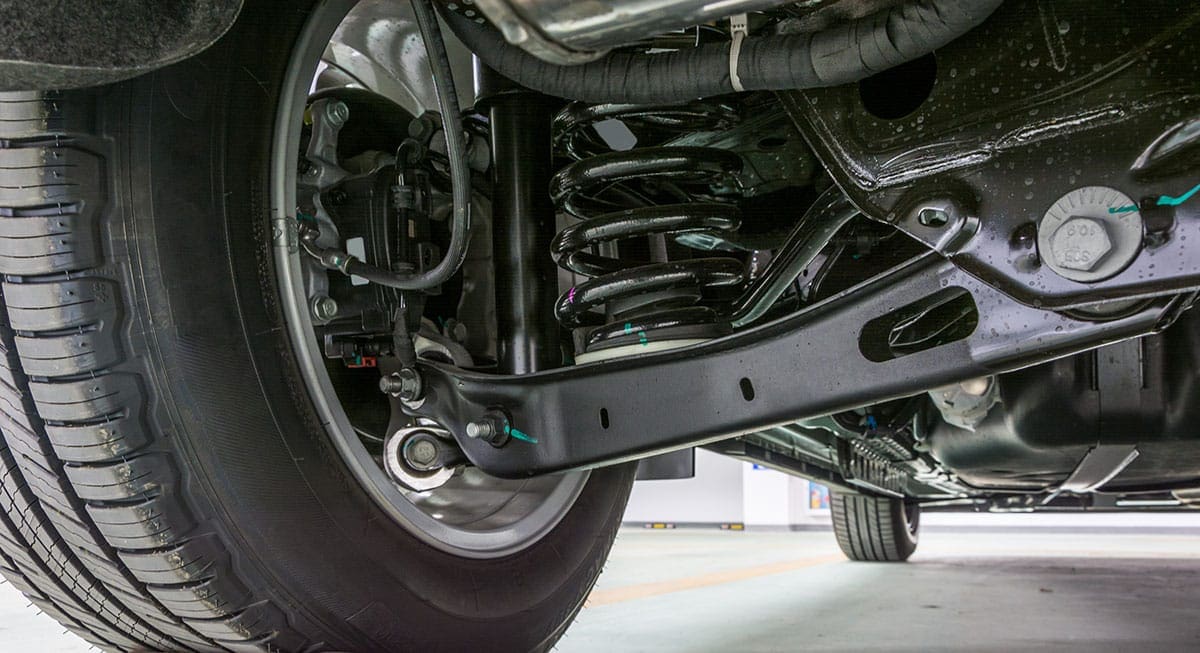
Shocks and struts both control suspension movement, but they are not interchangeable names for the same part. A conventional shock absorber is a separate damping component. A strut combines damping with a structural role in the suspension, and on some designs it is also part of the steering pivot.
That difference changes more than vocabulary. It can change the parts package, labor, alignment steps and what must be inspected before an estimate is comparable.
The short answer
| Question | Conventional shock | Strut |
|---|---|---|
| Main shared job | Controls spring and suspension movement | Controls spring and suspension movement |
| Structural suspension member | Generally no | Yes |
| Usually carries the spring in the same assembly | No; spring is separate | Often, but exact design controls |
| Can locate the steering knuckle or act as a steering pivot | No in a conventional separate-shock layout | Often on a steering axle |
| Common quote unit | Shock plus bushings/hardware | Bare strut or complete assembly, plus related components |
| Alignment after replacement | Depends on what was disturbed and exact procedure | Design-dependent; verify exact service information |
This is a layout guide, not a universal parts catalog. A vehicle may use struts on one axle and separate shocks on another. Some products are electronically controlled, self-leveling or integrated into a different suspension package. The VIN, suspension option and actual part location decide what the vehicle has.
What shocks and struts have in common
The vehicle’s springs compress and extend as the wheels move over the road. Without damping, that stored energy would continue moving the body and wheel after the original bump. Both shocks and struts provide damping to control that motion.
Monroe describes modern shocks and struts as velocity-sensitive hydraulic devices: their resistance changes with the speed of suspension movement. KYB similarly explains that springs handle the bump’s energy while shocks and struts damp the spring’s motion.
That shared job is why the terms get mixed together. It is also why a symptom such as repeated bouncing does not identify the vehicle’s layout or prove which component failed. Inspection must identify the position, part and condition.
What makes a shock different?
A conventional shock absorber is a separate component mounted between suspension or axle structure and the vehicle body or frame. Its primary job is damping. The spring and the suspension’s structural locating members do their own jobs elsewhere in the layout.
Monroe states that conventional shocks do not support vehicle weight. That statement is about a conventional separate shock absorber, not every product whose name includes “shock.” Coil-over, air-suspension and other application-specific assemblies need their own parts and service information.
On an estimate, “replace shocks” should still identify:
- front or rear;
- left, right or both sides;
- shock type and exact part number;
- included bushings, sleeves and hardware;
- electronic or self-leveling connections, if equipped;
- separate findings for mounts or related suspension parts; and
- the reason for any alignment or calibration line.
A shock-only quote should not silently absorb spring, control-arm, wheel-bearing or alignment work without a separate explanation.
What makes a strut different?
A strut is a damping unit and a structural suspension member. Monroe explains that a strut can take the place of an upper control arm and upper ball joint in a conventional layout, support the spring and help hold the tire in its aligned position. Its lower body commonly attaches to the steering knuckle.
That architecture creates more possible estimate units:
- a bare strut or replaceable cartridge;
- a complete or loaded strut assembly;
- an upper mount or steering-pivot bearing;
- a coil spring;
- a bumper, boot and spring insulators;
- position-specific hardware; and
- alignment measurement or adjustment.
The exact part package matters. Monroe’s complete-assembly explainer lists an upper mount, bumper and boot, spring insulators and coil spring in its loaded assembly. A bare strut does not include that same package. Those manufacturer definitions help compare quotes; they do not prove that a complete assembly exists for every vehicle or that every included component failed.
A simple suspension layout map
Use this decision map to understand estimate terminology:
At one wheel position
│
├─ Is the damper a separate unit from the spring and structural links?
│  └─ Usually described as a conventional shock layout
│
└─ Does the damper assembly also locate/support the suspension or steering knuckle?
   └─ Usually described as a strut layout
      ├─ Bare strut/cartridge path: inspect and transfer allowed components
      └─ Complete assembly path: verify every included component and part number
This map does not identify parts from a photograph or generic model name. It tells a customer which questions to ask after the shop identifies the actual suspension.
Can one vehicle have both shocks and struts?
Yes. A vehicle can use struts on one axle and conventional shocks on the other. It can also use different left/right part numbers or different suspension packages within one model line.
That is why a quote that says only “four shocks” or “front shocks” can be misleading even when the total is accurate. Ask the estimator to use the actual part names from the selected vehicle application and to list the axle and side.
Do not infer that a rear damper is a shock simply because the front uses struts, or that a front component is a strut because the vehicle is front-wheel drive. Current service information and the exact VIN/application control.
Why strut labor can differ from shock labor
A conventional shock is commonly separate from the spring. A strut assembly may contain a loaded coil spring and may be attached to the steering knuckle and upper body mount. Replacing a bare strut can require controlled spring compression and transfer of serviceable components.
KYB warns that coil springs are under high tension and that a spring compressor may be required for strut work, while one is not required for its complete assemblies. This article does not provide removal, spring-compression or installation instructions.
The labor difference is not captured by the words “shock” and “strut” alone. It depends on the exact design, access, fastener condition, part package and procedure. Ask the quote to identify those variables rather than relying on a generic labor assumption.
Does a strut quote include the spring and mount?
Not necessarily. “Strut” can mean the bare damping unit or a complete loaded assembly. A complete package may include a spring and upper components; a bare-unit repair may reuse them after inspection.
KYB’s current FAQ says many of its strut mounts include a bearing only where the mount is also the steering pivot and tells readers to check the exact application. That is a good estimate rule: never assume the mount, bearing, boot, spring or hardware is included because the line says “strut assembly.” Request the manufacturer and part number, then list the box contents.
The reverse matters too. A complete assembly contains more new components, but its use does not establish that every component failed. It can be a repair-package choice rather than a list of individual diagnoses.
Does replacing shocks or struts require an alignment?
The answer depends on the vehicle design and what the repair disturbs.
KYB’s FAQ states that some models are not affected when struts are replaced, while others change alignment; it recommends checking the specific service manual and specifications. That precise design-dependent statement outranks a blanket yes or no.
Because a strut can locate the steering knuckle, its removal can affect alignment or require verification. A conventional shock replacement may not alter wheel geometry by itself, but related disturbed components or ride-height changes can create a separate requirement. The estimate should state whether it includes:
- alignment measurement;
- actual adjustment;
- a before-and-after printout; and
- any exact-vehicle steering-angle or driver-assistance procedure.
Do not let “alignment included” hide which of those actions is priced.
Are shocks or struts automatically replaced in pairs?
KYB recommends replacing shocks and struts in axle pairs to maintain matched damping. A pair recommendation is not the same statement as “both parts failed.”
The quote should distinguish:
- the confirmed finding on each side;
- the manufacturer or shop rationale for matched replacement;
- whether both proposed units are the same type and specification; and
- whether mounts, bearings, springs and hardware are also one-side or paired items.
Do not extend a damper-pair recommendation into automatic replacement of every connected component. Each added part needs its own condition finding or an explicit package explanation. Exact vehicle procedures can also define different component scopes, so current service information controls.
Symptoms do not tell you whether the vehicle has shocks or struts
Bouncing, body movement, noise, fluid, uneven tire wear or a change in ride can justify inspection. They do not identify the suspension architecture or isolate a failed component by themselves.
KYB cautions that a shock or strut’s condition cannot be judged by compressing it by hand because hand pressure does not reproduce the operating forces and speeds. Monroe’s leakage guide also separates minor oil weepage from extensive wetness or dripping leakage. Those boundaries show why a visual or bounce observation needs context.
Ask for the exact finding at the exact wheel position. A noise could involve a mount, bearing, bushing, spring, sway-bar link or another component. Uneven tire wear can have pressure, alignment or other suspension causes. This comparison cannot diagnose the vehicle remotely.
Compare shock and strut estimates with the right fields
| Comparison field | Quote A | Quote B | Why it matters |
|---|---|---|---|
| VIN, year, make, model, trim and suspension option | Selects the real layout and parts | ||
| Front/rear and left/right position | Prevents axle or side confusion | ||
| Shock, bare strut, cartridge or complete assembly | Defines the repair unit | ||
| Part manufacturer and exact part number | Verifies fitment and package | ||
| Spring, mount, bearing, boot and hardware included | Makes the box contents visible | ||
| Finding for each replaced component | Separates evidence from package choice | ||
| One side or axle pair | Distinguishes quantity and rationale | ||
| Labor for disassembly/component transfer | Bare and loaded paths differ | ||
| Alignment measurement/adjustment/printout | Prevents hidden post-repair scope | ||
| Electronic or air-suspension procedure | Exact application may add steps | ||
| Taxes, fees and written parts/labor warranty | Makes the final total comparable | ||
| Conditional work and approval point | Limits open-ended authorization |
Two quotes are not comparable if one says “rear shocks” and the other says “front complete strut assemblies.” The table makes the mismatch obvious before the customer compares totals.
Questions to ask before approving the estimate
- Does this position use a conventional shock or a strut?
- Which axle and side are being repaired?
- What finding supports each proposed part?
- Is the strut bare, cartridge-style or a complete assembly?
- Are the spring, mount, bearing, boot, insulators and hardware included?
- Which components will be reused, and how were they inspected?
- What is the manufacturer and exact part number?
- If a pair is proposed, is that based on two findings or matched-damping guidance?
- Does the repair require an alignment check or adjustment for this exact vehicle?
- Is a printout included?
- Does the vehicle have electronic or self-leveling suspension?
- Which additions are confirmed and which remain conditional?
The practical answer
Shocks and struts share a damping job, but a strut is also structural. That difference can change the spring and mount package, labor, alignment scope and terminology on an estimate. Identify the actual layout first; then compare the same axle, quantity, part package and post-repair work.
For a Rowlett-area vehicle, Accelerate’s suspension inspection and repair service is the existing local owner. The Service page, not this national comparison, owns local inspection and repair intent.