

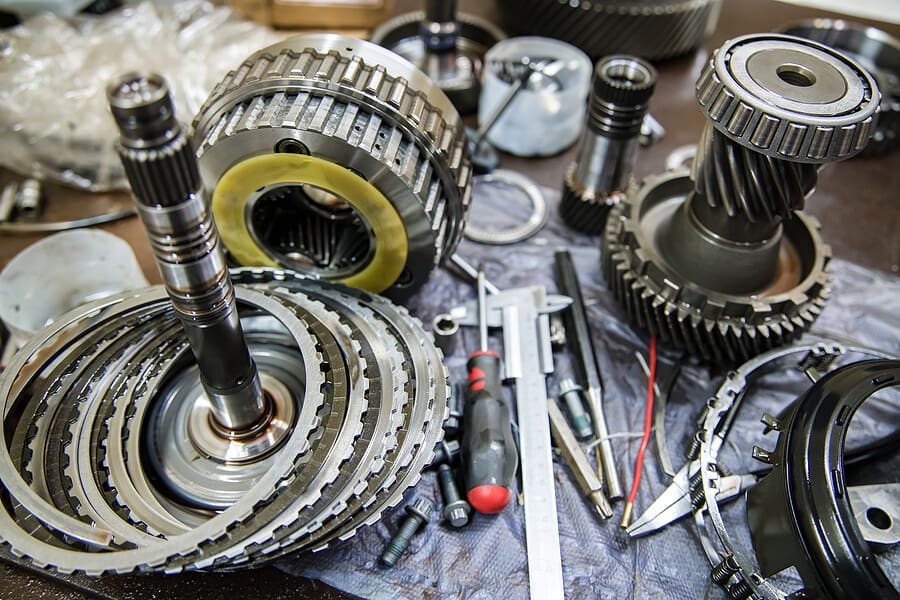
A transmission fluid change and a transmission flush are not the same service with different names. A change — also called a drain-and-fill — only replaces 20% to 40% of the fluid, per Jiffy Lube. A flush uses machine equipment to push fluid through the cooler lines and replace nearly all of it. The two differ in fluid volume, equipment, cost, and — on some vehicles with existing problems — whether it’s the right move at all. If the transmission itself has failed, see what a transmission replacement costs.
What a drain-and-fill actually replaces
A standard fluid change only touches the fluid sitting in the pan, not the fluid still circulating through the torque converter and cooler lines. Jiffy Lube describes the process: "The transmission pan is lowered and drained. The filter is replaced (if necessary). The technician reinstalls the pan. Then the transmission is refilled with fresh ATF." The catch is volume — Jiffy Lube states plainly that "a fluid change only drains 20% to 40% of the total ATF volume."
YourMechanic’s description of the same basic service lines up: "Drain the transmission fluid. (Automatic only) Install new pan gasket and filter (if replaceable). Add the proper type and quantity of oil/fluid for your transmission. Check for leaks. Test drive the vehicle." YourMechanic calls this a "Transmission Fluid Service" rather than using the word "flush" — worth noting, since shops don’t always use the two terms the same way.
The math matters: if 60% to 80% of the old fluid stays in the system after a "change," most of its contaminants and heat-cycled additive package stay too, diluted by the fresh fluid added.
What a flush replaces
A flush is a different piece of equipment doing a different job. Jiffy Lube’s description: "All the old, dirty fluid is removed. A special solution is run through the cooler lines. The filter is replaced (if necessary). Then the transmission is refilled with fresh ATF." AAA’s automatic transmission fluid article confirms the fluid pathway extends well beyond the pan — ATF "transmit[s] power, operate[s] hydraulic systems, provide[s] lubrication, keep[s] seals soft, protect[s] internal transmission components and act[s] as coolants" as it circulates, which is why a pan-only drain leaves so much of it untouched.
Jiffy Lube makes the case for the flush directly: "With a flush, all the old fluid is removed by a flush machine and replaced with new fluid, allowing for optimal transmission performance," versus a change, where "some old fluid remains in the transmission after the change, which can contaminate the new fluid — and diminish performance." The tradeoff is cost: "a transmission flush usually costs significantly more than the less complicated fluid change."
| Drain-and-fill (change) | Machine flush | |
|---|---|---|
| Fluid volume replaced | 20-40% (Jiffy Lube) | Nearly all of it (Jiffy Lube) |
| Torque converter and cooler lines | Fluid there is not exchanged | Fluid there is exchanged |
| Filter | Replaced if serviceable, both services | Replaced if serviceable, both services |
| Equipment | Pan removal, gravity drain | Flush machine, cooler-line connection |
| Typical cost | Lower | Higher — "significantly more," per Jiffy Lube |
| Source | Jiffy Lube; YourMechanic | Jiffy Lube |
What a pan drop with filter adds
A pan drop is the mechanical core of a proper drain-and-fill on a vehicle with a serviceable pan and filter, not a separate third category. YourMechanic’s process covers it: the pan is removed, and on automatic transmissions with a replaceable filter, "install new pan gasket and filter (if replaceable)" happens before refill. Not every transmission has a pan that comes off, and not every pan-equipped transmission has a swappable filter — both sources frame filter replacement as conditional ("if replaceable" / "if necessary").
The "a flush will damage a high-mileage transmission" claim
This is the claim that stops a lot of drivers from booking a flush, and it has a real basis — just a narrower one than "never flush an old transmission."
AAA’s technicians name the actual mechanism. Eric Carlson, a master hybrid technician quoted in AAA’s transmission-fluid-myths article, explains that "if a transmission is already slipping or damaged, a fluid change won’t repair worn components" and that "it’s best to have the system properly diagnosed before assuming a fluid change will help." AAA goes further: "a transmission service can exacerbate problems that are already present in your vehicle if maintenance has been irregular. For this reason, some shops require a liability waiver if a new customer with an older car insists on a transmission fluid service."
The mechanism isn’t equipment attacking a healthy transmission — a unit already running on worn or damaged clutch material can have that debris disturbed when the fluid is fully exchanged. A fluid service doesn’t create that condition; it can expose or accelerate one already there.
That’s a different claim than "any flush on any older car is dangerous." AAA’s own guidance runs the other way on a healthy high-mileage unit: "regular fluid changes help keep your transmission shifting smoothly and extend its lifespan," and "the only way to prevent transmission failure is to change the fluid," per Carlson. The distinction is condition, not age or mileage alone. A vehicle already showing a symptom — see torque converter shudder symptoms and diagnosis — should be diagnosed before a fluid service is booked to try to fix it.
When each service is appropriate
| Situation | What the sources support | Source |
|---|---|---|
| Vehicle is within its manufacturer’s normal fluid-service interval, no symptoms | Drain-and-fill or flush per manufacturer guidance and fluid condition | AAA; Jiffy Lube |
| Fluid is dark brown or black, or smells burnt | Replacement warranted; those signs indicate "more serious transmission problems that call for diagnosis" | AAA (ATF service article) |
| Vehicle is already slipping, shifting hard, or shuddering | Diagnose first — a fluid service "won’t repair worn components" | AAA (myths article) |
| Vehicle has a sealed or "non-serviceable" transmission | Still needs service on a schedule; sealed ≠ maintenance-free | AAA; Jiffy Lube |
| Irregular or unknown maintenance history | Some shops require a liability waiver first; diagnosis before service is the safer order | AAA (myths article) |
Manufacturer intervals vary widely. AAA’s myths article: "The guidelines for most vehicles recommend draining and replacing the transmission fluid every 30,000 to 150,000 miles," with the owner’s manual as the actual authority — too wide a range to answer from a make and model alone.
What each service includes, and what it typically costs
No fetched source in this draft states a national flat-rate dollar figure for a machine flush specifically. YourMechanic’s published pricing is for its drain-and-fill "Transmission Fluid Service," not a flush:
| Vehicle | Parts cost | Labor cost | Total estimate | Savings vs. dealer | Source date |
|---|---|---|---|---|---|
| 2008 Scion tC | $92.00 | $145.99 | $238 | -19% | Accessed Sept. 2026 |
| 2013 Volkswagen Jetta | $164.43 | $145.99 | $310 | -14% | Accessed Sept. 2026 |
| 2015 Ford Explorer | $155.28 | $262.78 | $418 | -19% | Accessed Sept. 2026 |
| 2014 Lincoln MKZ | $103.11 | $262.78 | $366 | -23% | Accessed Sept. 2026 |
| 2010 Cadillac STS | $131.21 | $233.58 | $365 | -20% | Accessed Sept. 2026 |
These figures are YourMechanic’s own published estimates for a drain-and-fill only, not a flush, and not AAR’s pricing. Jiffy Lube states only that a flush "usually costs significantly more" than a change, without a dollar figure — directional, not a quoted range. No fetched source prices a pan drop with filter separately from a general drain-and-fill. Named gaps below, not estimates.
Why some manufacturers specify lifetime fluid or a specific procedure
"Sealed" and "lifetime" don’t mean "never needs attention." AAA’s automatic transmission fluid article: "Many late-model cars use synthetic lifetime transmission fluids and have sealed transmissions without a dipstick to check the fluid level," and "even some cars with dipsticks use ‘lifetime’ fluids that either never need changing, or are changed only at extended intervals that can exceed 100,000 miles."
AAA’s myths article closes the loop on why that label confuses owners: "Some transmissions are labeled ‘non-serviceable’ or ‘sealed.’ That can confuse car owners, since it suggests that service isn’t needed. What that really means is that there’s no easy dipstick access; it doesn’t mean they’re actually maintenance-free," per Carlson. "These systems still have filters and fluid that wear out over time. They require specialized equipment to be adequately serviced." Carlson adds that "some non-serviceable transmissions — such as those found in some Hondas — need to be serviced as often as serviceable transmissions." Jiffy Lube confirms the point from a different angle: "with some vehicles, transmission fluid change vs. flush is irrelevant, as they may have a sealed transmission." The choice to seal a transmission or specify lifetime fluid is a design and warranty decision, not evidence the fluid is exempt from wear.
Sealed transmissions and the level-check procedure
On a vehicle with a dipstick, AAA lays out the check in order: stop on a level surface with the parking brake on and the engine idling; move the shifter "through all gear positions, pausing for a few seconds in each," then park or neutral; remove the dipstick, wipe it clean, read the markings, then reinsert fully and remove again for the actual reading. AAA notes "around 15 minutes of driving is typically required to fully warm up the transmission" before the check is accurate.
Fluid color is part of the same check. AAA: "New automatic transmission fluid has a red or pink tint. Fluid that is reddish-amber to medium brown has been in service for some time, but a color change of this type is normal and not a cause for immediate fluid replacement. However, a dark brown or black color is a sign of deteriorated fluid that needs to be changed. Fluids that have a milky appearance, or smell burnt, indicate more serious transmission problems that call for diagnosis by a qualified auto mechanic as soon as possible." For a sealed transmission with no dipstick, that visual check isn’t available to the owner at all — one more reason "no dipstick, no problem" is the wrong read on a sealed unit.
Signs you’re being quoted the wrong service
A quote can use the right words and still be for the wrong job:
- A "flush" quote that’s actually a drain-and-fill, or the reverse. The two sources don’t use the terms identically — YourMechanic’s drain-and-fill is labeled "Transmission Fluid Service," not "flush." Ask what percentage of fluid the service replaces, not just the word on the invoice.
- A flush recommended for a transmission already slipping or shuddering, with no diagnosis first. That’s the exact situation where a fluid service can expose or worsen a problem rather than fix it.
- A quote with no filter line item on a vehicle that has a serviceable filter. Both sources list filter replacement as conditional — worth confirming.
- A "lifetime fluid, never needs service" answer on a vehicle with real mileage. True for some vehicles and false for others, per AAA — including some sealed Honda transmissions.
When fluid service will not fix a shifting problem
A fluid change or flush is maintenance, not a repair for an existing mechanical fault. Per Carlson and AAA above: "If a transmission is already slipping or damaged, a fluid change won’t repair worn components." A shudder has its own diagnostic path — see torque converter shudder symptoms and diagnosis — and a vehicle being cross-shopped for a swap or rebuild is a different decision; see 4L60E vs 4L80E fit, ratings and swap scope. Neither is restated here.
No fetched source supports diagnosing a shifting complaint from a written description alone — low fluid, a failing sensor, and a mechanical fault all need the vehicle in the shop to tell apart.
What to ask before you approve the repair
- Does the quote describe a drain-and-fill or a machine flush, and does a "flush" label actually exchange fluid in the cooler lines and torque converter, or just the pan?
- What percentage of the fluid does the quoted service replace?
- If there’s an existing shifting symptom, was it diagnosed before a fluid service was recommended as the fix?
- Does your vehicle have a sealed or "lifetime fluid" transmission, and does the quote reflect the specialized equipment that requires?
- Is filter replacement included, and does your transmission have a serviceable filter?
- If the vehicle has irregular maintenance history, has the shop discussed the tradeoff AAA describes — that fluid service on an already-compromised transmission can expose problems rather than cause them?
A shop that can answer all six is quoting the actual service your vehicle needs.
None of this is a claim that any specific vehicle needs a flush, a drain-and-fill, or any transmission service at all. Fluid condition, mileage, interval, and any existing symptom all factor in, and a real diagnosis checks them first.
For a Rowlett-area vehicle with a transmission fluid question, a shifting symptom, or a quote you’d like a second look at, Accelerate’s engine and transmission repair service is the existing local owner for tracing a transmission concern to its actual cause before any service is recommended. That link is not a claim that fluid service itself is priced or guaranteed there.