

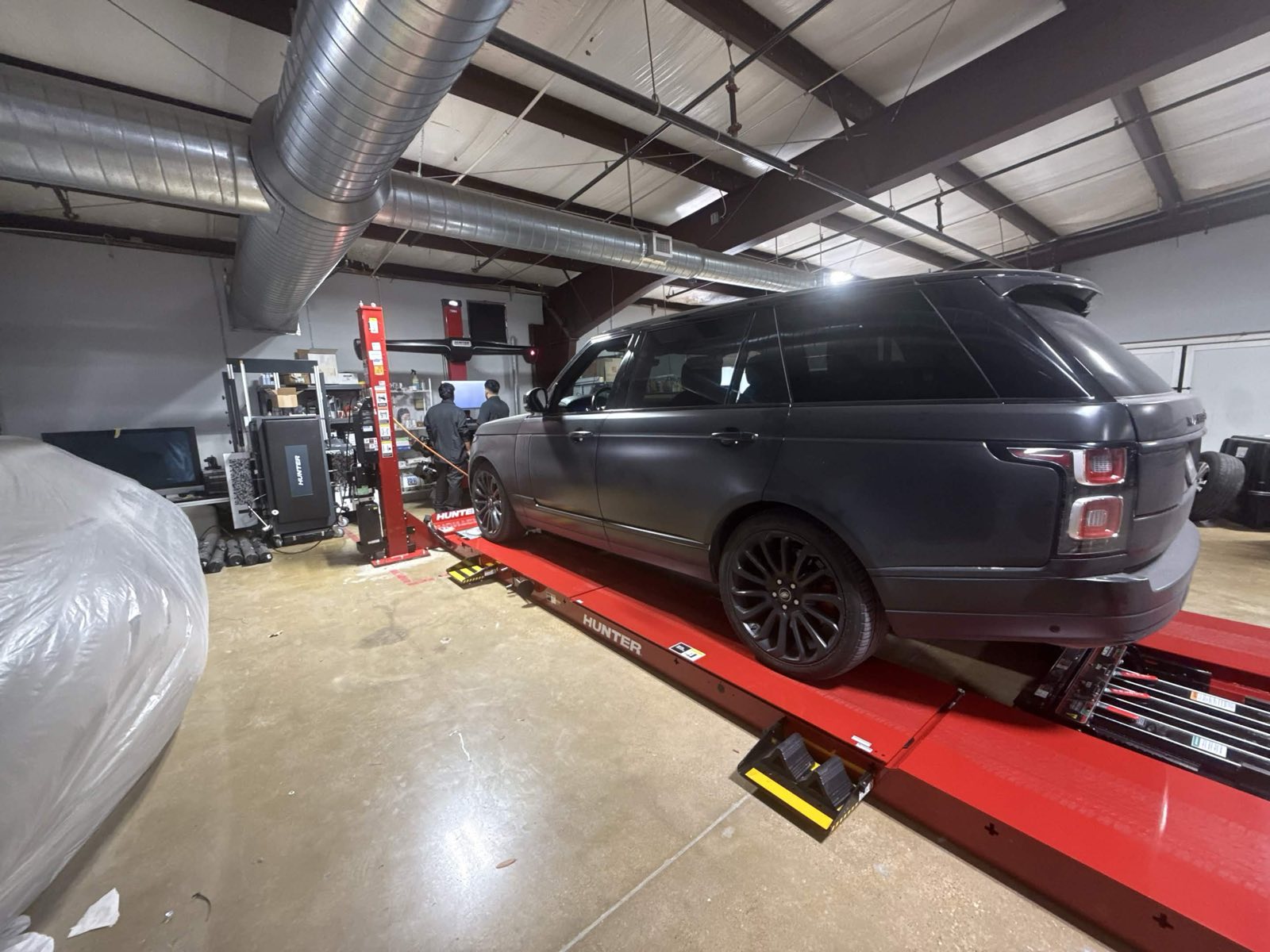
A wheel alignment typically runs $100 to $273, depending on the shop, the vehicle, and whether it’s a two-wheel or four-wheel job. AAA puts a standard four-wheel alignment at $100 to $168, while RepairPal’s national estimator lists the labor range at $186 to $273, current as of RepairPal’s September 3, 2026 update. Neither of those figures includes ADAS camera or sensor calibration, which many newer vehicles need as a separate step after the alignment itself.
What a wheel alignment actually is
An alignment adjusts your suspension’s angles so the tires meet the road correctly and the steering wheel sits straight when you’re driving straight. AAA describes the process as adjusting three settings: camber (how much the wheel tilts in or out at the top), caster (the forward-or-backward tilt of the steering pivot, which governs how well the wheel re-centers after a turn), and toe (whether the front edges of the tires point slightly in, slightly out, or straight ahead). SPC Alignment, a chassis-parts and alignment-equipment manufacturer, adds a fourth angle to the picture: thrust, which confirms the rear axle is square to the front axle and the wheelbase matches on both sides of the car. When thrust is off, SPC notes it shows up as "steering wheel misalignment, ‘dog-tracking’, vehicle ‘pulls’ and tire wear." Rotating on schedule helps the tires wear evenly; see what a tire rotation costs.
Alignment is a different service than tire balancing. AAA is explicit on this point: alignment corrects the direction the tires point, while balancing corrects uneven weight distribution in the wheel-and-tire assembly so it doesn’t wobble at speed. A shop that quotes you a "balance and alignment" as one line item is doing two different jobs.
Two-wheel, four-wheel, and thrust-angle alignment
Not every alignment touches every wheel. AAA lays out the difference plainly:
- Two-wheel (front-end) alignment. Adjusts the front wheels only, leaving the rear untouched. AAA notes it’s "slightly more affordable than doing all four at once" but "not often offered at repair facilities," since most modern vehicles have adjustable rear suspension too.
- Four-wheel alignment. Adjusts camber, caster, and toe at both the front and rear axle. AAA says this option "ensures all of your tires are road ready," and it’s the standard job at most shops now.
- Thrust-angle check. Built into a proper four-wheel alignment rather than sold separately in most shops. It’s the measurement confirming the rear axle points straight relative to the front, per SPC’s definition above. If your car has non-adjustable rear suspension, a shop can still measure thrust angle even if it can’t adjust the rear angles themselves.
If a shop only mentions "front-end alignment" on the quote and your vehicle has independent rear suspension, ask whether the rear was measured at all. Skipping it means a thrust-angle problem in the back can go undiagnosed.
What’s in the quote
RepairPal’s process description for a wheel alignment covers the mechanical steps: the vehicle goes on a lift with laser alignment equipment (RepairPal describes "four alignment heads, one attached to each wheel") that measures the current camber, caster, toe, and thrust angles against the manufacturer’s specification, and a technician makes the adjustments the machine calls for. That labor is the bulk of what you’re paying for. Alignment doesn’t consume parts the way a brake job or a gasket replacement does, which is part of why the national range is tighter than most repair categories.
| Line item | What it covers | Source |
|---|---|---|
| Pre-alignment inspection | Technician checks tie rods, ball joints, and bushings for play before adjusting anything | AAA |
| Machine measurement | Laser/sensor readout of camber, caster, toe, and thrust angle against factory spec | RepairPal |
| Adjustment | Technician brings each angle within manufacturer tolerance | RepairPal |
| Post-alignment printout | Before/after readings confirming the car is within spec | RepairPal |
| ADAS recalibration (if equipped) | Separate step, separate line item, see below | Moog; AAA |
Why the price swings between vehicles
RepairPal’s own per-vehicle examples, priced the same week as the $186-$273 national labor range above, show how much the total can move by make and model:
| Vehicle | RepairPal estimate |
|---|---|
| Honda CR-V | $134 – $196 |
| Honda Civic | $137 – $200 |
| Honda Accord | $157 – $231 |
| Nissan Altima | $161 – $236 |
| Chevrolet Silverado 1500 | $166 – $243 |
| Ford F-150 | $188 – $276 |
| Toyota Corolla | $189 – $277 |
| Toyota Camry | $223 – $326 |
That’s roughly a $190 spread across eight common vehicles, with no repair parts involved. The difference is labor time, which varies by how the suspension is built and how many angles are adjustable on that platform.
The part that has to be right before the alignment can hold
A car can go through a full alignment and be out of spec again within days if a steering or suspension component is worn. Moog, a supplier of steering and suspension parts, explains the tie rod’s role directly: replacing an outer tie rod changes the toe setting, which can cause "an out-of-spec toe reading on both sides since the toe will ‘equalize’ as the vehicle is driven down the road." That means a worn or recently replaced tie rod has to be accounted for in the alignment, not just bolted on and ignored. Moog’s own figure on the stakes: being misaligned by as little as one degree can cause premature wear on both front tires.
That’s why a pre-alignment inspection matters as much as the adjustment itself. AAA’s description of the alignment process notes that misalignment over time causes wear in "control arms, ball joints and bushings," the same parts that, if already worn before the alignment starts, will pull the car back out of spec almost immediately. If a shop finds a bad tie rod, ball joint, or bushing during the inspection, that’s a repair on top of the alignment cost, not included in it. AAA separately notes that suspension repairs run anywhere from about $150 to well over $1,000 depending on the parts involved, a wide range because "what kind of work needs to be done" varies so much by vehicle and failure. A worn joint or bushing found in that inspection is its own repair; see what a control arm replacement quote should include.
If your car already needs a tie rod, Accelerate’s tie rod replacement cost article covers what that job runs and what’s in that quote separately from the alignment.
When ADAS calibration adds a separate cost
Many current vehicles carry forward-facing cameras or radar units, for lane-keep assist, automatic emergency braking, and adaptive cruise, that are calibrated relative to the car’s straight-ahead position. AAA’s guidance on ADAS calibration is blunt about how little tolerance these systems have: "a sensor on the car that is out of alignment by a fraction of an inch or even one degree will be aimed at an area significantly off axis 50 or more feet down the road." AAA lists wheel alignment explicitly among the common service jobs that can trigger a calibration requirement, alongside windshield replacement, suspension repair, and tire size changes.
Moog’s guidance on tie rod work makes the same point from the steering-sensor side: "changes to alignment settings, even slight adjustments, can have a big effect on the performance of ADAS functions," which is why a steering angle sensor recalibration, confirming the sensor correctly reads the car’s true straight-ahead position, often follows an alignment on ADAS-equipped vehicles. Moog notes this recalibration can typically be done with the alignment machine itself or a separate scan tool.
Neither AAA nor Moog publishes a specific dollar add-on for this step in the pages fetched for this draft, so no ADAS calibration price is stated here. AAA does note that the calibration process itself is "frequently complex and time consuming," running from about 15 minutes to over an hour depending on the vehicle, and that the added labor time is what increases the total bill. If your car has adaptive cruise, lane-keep assist, or automatic emergency braking, ask upfront whether the alignment quote includes calibration or whether it’s a separate line item. If the shop doesn’t do calibration in-house, ask where the car goes for that step and how it affects the timeline.
Signs your car needs an alignment
AAA lists the signs that point to a car being out of alignment:
- The vehicle pulls to one side on a flat, straight road
- The steering wheel isn’t centered even though you’re driving straight
- Tires show uneven or accelerated wear on the inner or outer edge
- Steering feels hypersensitive, loose, or sluggish
- Tires squeal on turns you’d normally take without noise
Any one of these on its own is worth a look. Together, they’re a strong sign the car has been out of spec for a while, since uneven tire wear in particular takes time to develop.
How often to get one
AAA’s recommendation is an alignment check about once a year, plus any time one of these happens: you install new tires, or you hit a significant pothole or curb. Hitting a curb hard enough to feel it in the wheel is a common, easy-to-miss trigger. The impact can knock a wheel out of spec without leaving any visible damage.
What to ask before you approve the alignment
- Is this quoted as a two-wheel or four-wheel alignment, and does that match what your vehicle’s rear suspension can actually adjust?
- Did the pre-alignment inspection check the tie rods, ball joints, and bushings for play before any adjustment was made?
- If a worn part was found, is its replacement cost separate from the alignment cost, and is that itemized?
- Does your vehicle have ADAS features (lane-keep assist, adaptive cruise, automatic emergency braking), and does the quote include calibration or is that billed separately?
- Will you get a before-and-after printout showing the readings versus the manufacturer’s spec?
A shop that can answer all five is quoting the actual job your car needs, not a generic line item.
None of this is a claim that any specific vehicle needs an alignment, new tie rods, or ADAS calibration. AAA’s own description of the process (inspect, measure against factory spec, adjust, confirm) exists because a car that pulls or wears tires unevenly can trace back to more than one cause, and a real diagnosis finds the actual one before you pay for the fix.
For a Rowlett-area vehicle that’s pulling, wearing tires unevenly, or due for a check after new tires or a pothole hit, Accelerate’s wheel alignment service in Rowlett is the local page for that job. If your vehicle also needs ADAS camera or sensor work after the alignment, Accelerate’s ADAS calibration service in Rowlett covers that separately. Neither link is a claim that this national cost data reflects AAR’s own pricing.