

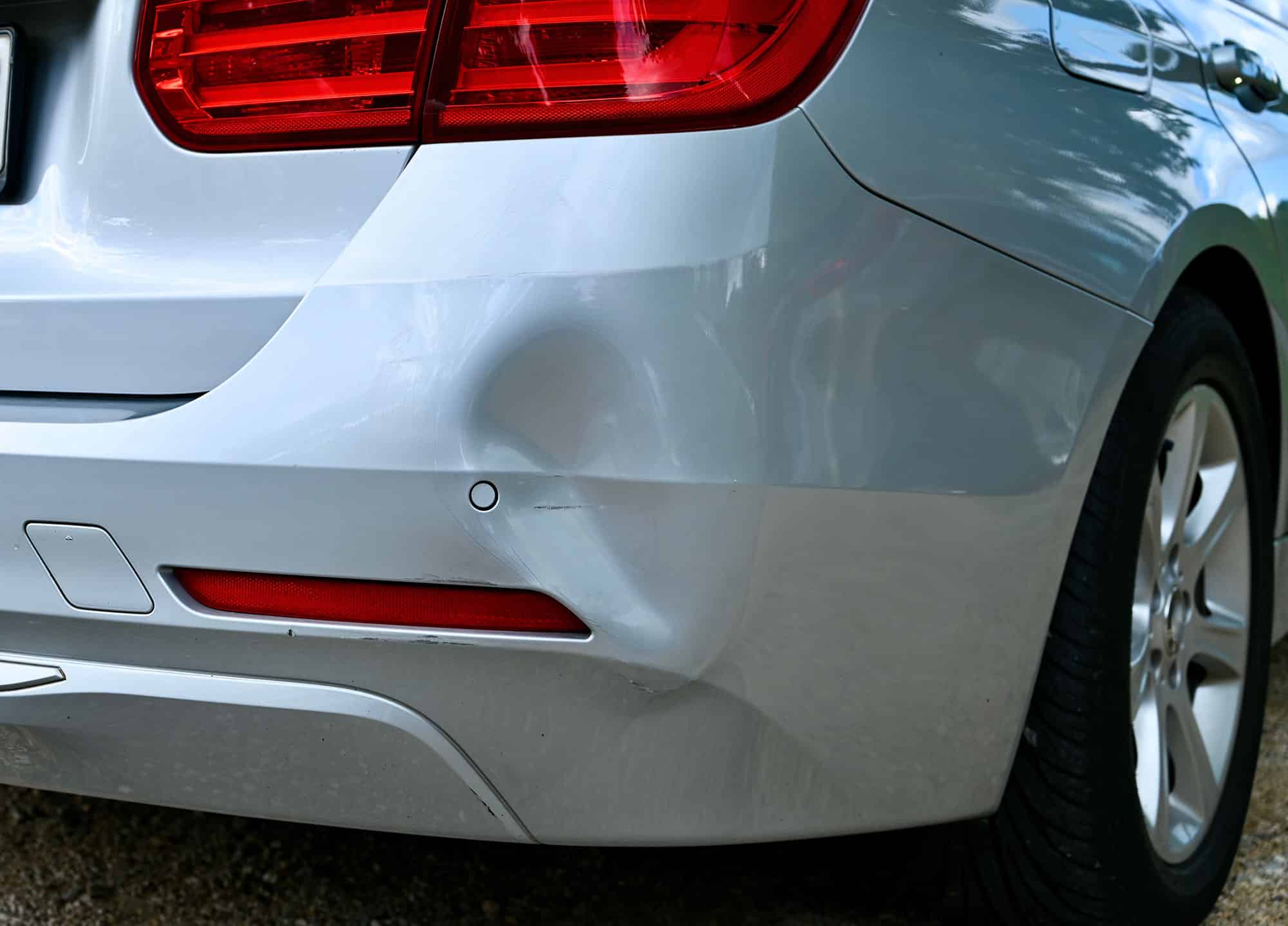
A bumper repair estimate is built from five things: whether the shop can repair the plastic or has to replace it, what’s mounted behind the cover, whether the paint has to blend into next-door panels, where the replacement part comes from, and whether a sensor needs to be recalibrated afterward. Change any one of those and the number on the estimate moves. This page walks through each factor and shows real, dated repair examples — it does not quote AAR’s own prices or tell you what your car needs.
Repair vs. replace: the decision that sets the whole estimate
A repair-or-replace call is the first fork in any bumper estimate, and it decides almost everything that follows.
Modern bumper covers are usually reinforced plastic — polypropylene-based composites molded to a specific shape. A shop generally has four paths available on a damaged cover: repair the existing plastic (filling and reshaping a crack or gouge), tab repair (rebuilding a broken mounting tab so the cover seats correctly), refinish only (color-sand and repaint a scuffed but structurally sound cover), or replace the cover outright when the damage, sensor location, or manufacturer position rules out repair. Behind the cover, a separate reinforcement bar and an energy absorber can be damaged independently of the visible cover and may need their own repair-or-replace call. A dent that sits on a steel panel rather than a plastic cover is priced differently; what a car dent repair quote includes explains that split.
| Path | What it addresses | What it does not address |
|---|---|---|
| Plastic/crack repair | Cracks, gouges, small punctures in an otherwise intact cover | Sensor-zone damage a manufacturer restricts from repair, torn mounting structure |
| Tab repair | Broken or torn mounting tabs and clips | Cover surface damage, sensor alignment |
| Refinish only | Scuffs, scrapes, faded or mismatched paint on a sound cover | Cracks, dents, deformation, sensor-zone damage |
| Cover replacement | Damage beyond repairable limits, sensor-zone restrictions, deformation | Damage to the reinforcement bar or energy absorber behind the cover |
| Reinforcement/absorber replacement | Damage to the structure behind the cover | The cover itself, which is assessed separately |
Which path applies is a vehicle-specific, damage-specific call the shop makes after inspection — not something this page can decide from a description or photo.
What’s really behind a modern bumper cover
The plastic cover most people call "the bumper" is a cosmetic shell over a structure built to manage low-speed impact energy.
Federal rule 49 CFR Part 581 sets the impact standard that shapes this structure: it requires passenger vehicles to withstand pendulum impacts at 2.5 mph (longitudinal) and 1.5 mph (corner), plus a 2.5 mph flat-barrier impact, without damage to specified safety systems. That standard is why a reinforcement bar and an energy absorber sit behind the visible cover on most vehicles — they’re the parts actually doing the low-speed energy management the cover only conceals.
How ADAS sensors change a bumper repair
On a growing share of vehicles, the bumper area also houses radar, ultrasonic, or camera components tied to driver-assistance systems, and that changes what "repair" is allowed to mean.
Hyundai’s I-CAR-published position statement on repairing bumpers with corner radar units is explicit on the boundary: technicians should "mask off the corner radar units or remove them from the vehicle to prevent contamination and paint overspray" during a repair, and if a radar unit is "damaged, contaminated, or had paint overspray during the refinishing process," it "must be replaced and recalibrated according to shop manual procedures." The same statement adds that plastic repairs to the bumper are not recommended in sensor zones because "the altered shape/surface of the bumper may affect corner radar performance." That’s a single manufacturer’s position for a specific sensor type — it illustrates the category of restriction, not a universal rule for every vehicle.
Why paint blending shows up as its own line item
A repaired or replaced bumper cover rarely gets painted in isolation — the color and clear coat usually have to disappear into the panels next to it, and that’s a separate cost driver from the plastic work itself. Hail is counted per dent across many panels, not as one bumper job; see what a hail damage repair quote includes.
Blending — feathering new color into adjacent, undamaged panels so the eye can’t find the edge — is standard collision-industry practice for matching a repainted panel to the rest of the vehicle. I-CAR’s own curriculum notes a limit on this technique worth knowing before you approve an estimate: "Blending the clearcoat is likely not covered by the paint maker’s warranty and is definitely not covered by the vehicle maker’s warranty." That’s a paint-industry position, not an AAR warranty statement.
OEM vs. aftermarket vs. recycled bumper covers
Where the replacement part comes from is a separate decision from the repair method, and it’s one an estimate should state plainly rather than bury in a parts code.
Three sourcing categories typically show up on a bumper estimate: OEM (made by or for the vehicle’s manufacturer), aftermarket (made by an independent parts manufacturer to fit the same vehicle), and recycled/LKQ (a used OEM part pulled from another vehicle). The Certified Automotive Parts Association (CAPA) runs a certification program aimed at the aftermarket category specifically. Its ANSI/CAPA standard 201-001-2019 covers dimensional stability testing specific to bumper covers, including adhesive, coating, fastener, and vehicle-test-fit checks. Not every aftermarket part carries CAPA certification, and certification status is a fact to ask about, not assume.
| Source | What’s generally true | What still depends on the vehicle |
|---|---|---|
| OEM | Made to the manufacturer’s original spec and tooling | Availability, lead time, cost |
| Aftermarket, CAPA-certified | Tested against the OEM part under ANSI/CAPA 201-001-2019 | Fit and finish on the specific vehicle; sensor-zone use may be restricted by the manufacturer |
| Aftermarket, non-certified | No independent comparative testing on record | Quality and fit vary by manufacturer |
| Recycled/LKQ | A used OEM part from another vehicle | Prior condition, paint match, mileage-equivalent wear |
An insurer’s preferred-parts policy, not just the shop’s recommendation, often drives which category appears on the estimate first — ask which one is being proposed and why.
What ADAS calibration adds to the bill
Even when the cover itself is a straightforward repair or replace, a calibration line can be the difference between a small ticket and a much larger one.
Industry claims data from CCC Intelligent Solutions’ Q4 2025 Crash Course report shows how common this has become: calibrations "rose to more than 35%" of appraisals through Q3 2025, specifically 35.6%, up from 26.9% in Q3 2024. The same report puts the year-to-date average total cost of repair at $4,768 through Q3 2025, up 1.4% year over year — a fleet-wide figure, not a bumper-specific one, but it shows the direction repair costs are moving as calibration work becomes routine rather than rare. Whether a specific bumper job needs a calibration depends on whether a sensor was removed, replaced, or could have been disturbed — a fact the shop determines from the vehicle, not from this page.
Insurance claim or self-pay: what to weigh before you decide
Whether to file a claim or pay out of pocket is a math-and-risk question, not a legal one, and it’s worth working through before repairs start rather than after.
The Illinois Department of Insurance’s consumer guidance on filing with your own carrier lays out the basic mechanics plainly: your deductible is subtracted from the settlement "each time you submit a claim," you’re free to choose your own repair shop, and there’s no law capping how many estimates an insurer can require before approving repairs. It also flags that insurers treat an inflated estimate designed to help a customer recover their deductible as fraud. None of that is legal advice, and none of it says whether filing makes sense for a specific repair — that comparison is between the estimated cost and your own deductible, plus how a claim might affect renewal pricing, which varies by insurer and state.
Dated example estimates: what real bumper repairs have cost
Real, sourced numbers show the range better than a made-up one. Two independent, dated examples:
| Vehicle / scope | Cost | Date / source |
|---|---|---|
| 2017 Cadillac XT5, rear bumper strike into a pole — bumper cover, tailgate, hitch bar, energy absorber, rear body panel, trim and assorted brackets | $3,477 | IIHS rear crash prevention test report, published February 22, 2018 |
| Aggregate repairable appraisals, all damage types, U.S. fleet | Average total cost of repair: $4,768 (YTD through Q3 2025) | CCC Intelligent Solutions, Q4 2025 Crash Course report |
The XT5 figure is one vehicle, one test scenario, one point in time — it is not a price range for any current-year vehicle or any AAR estimate. The CCC figure is a fleet-wide repair average across all damage types, not a bumper-specific number. Both are shown as dated, sourced examples of how a real estimate itemizes and totals, not as a prediction for any reader’s repair.
What can make an estimate change mid-repair
An estimate written before disassembly is a starting point, not a final number, and knowing why it moves helps you read a revised one.
Removing the cover can expose reinforcement or absorber damage that wasn’t visible from outside. A sensor thought to be reusable can test out of tolerance once the technician checks it, adding a calibration line that wasn’t on the original estimate. A part ordered as one sourcing category can be substituted for another if the first isn’t available in a reasonable timeframe — that substitution should come back to you before it’s made, not appear on the final invoice.
What to ask before you approve the work
You don’t need to diagnose the repair yourself. A short list of questions gets you a clearer estimate:
- Is this a repair, a refinish, or a full cover replacement — and why?
- Does the reinforcement bar or energy absorber need attention too?
- Are any sensors in the repair area, and will they need scanning or calibration?
- Will the paint blend into adjacent panels, and is that priced separately?
- What part category — OEM, aftermarket, or recycled — is being proposed, and is it CAPA-certified if aftermarket?
- What happens to the estimate if teardown finds more damage?
- If you’re filing a claim, how does the estimated cost compare to your deductible?
For a Rowlett-area vehicle, Accelerate’s bumper repair service is the existing local owner for getting those questions answered against your actual vehicle. That link does not diagnose damage, quote a price, or promise a specific repair outcome.
The practical answer
A bumper repair estimate is not one number — it’s the sum of a repair-or-replace decision, what’s mounted behind the cover, whether paint has to blend into neighboring panels, where the replacement part comes from, and whether a sensor needs recalibration. Change any of those five factors and the total changes with it. The way to read an estimate well is to ask which of the five it’s charging for, not to compare a single total against a number you saw somewhere else.