

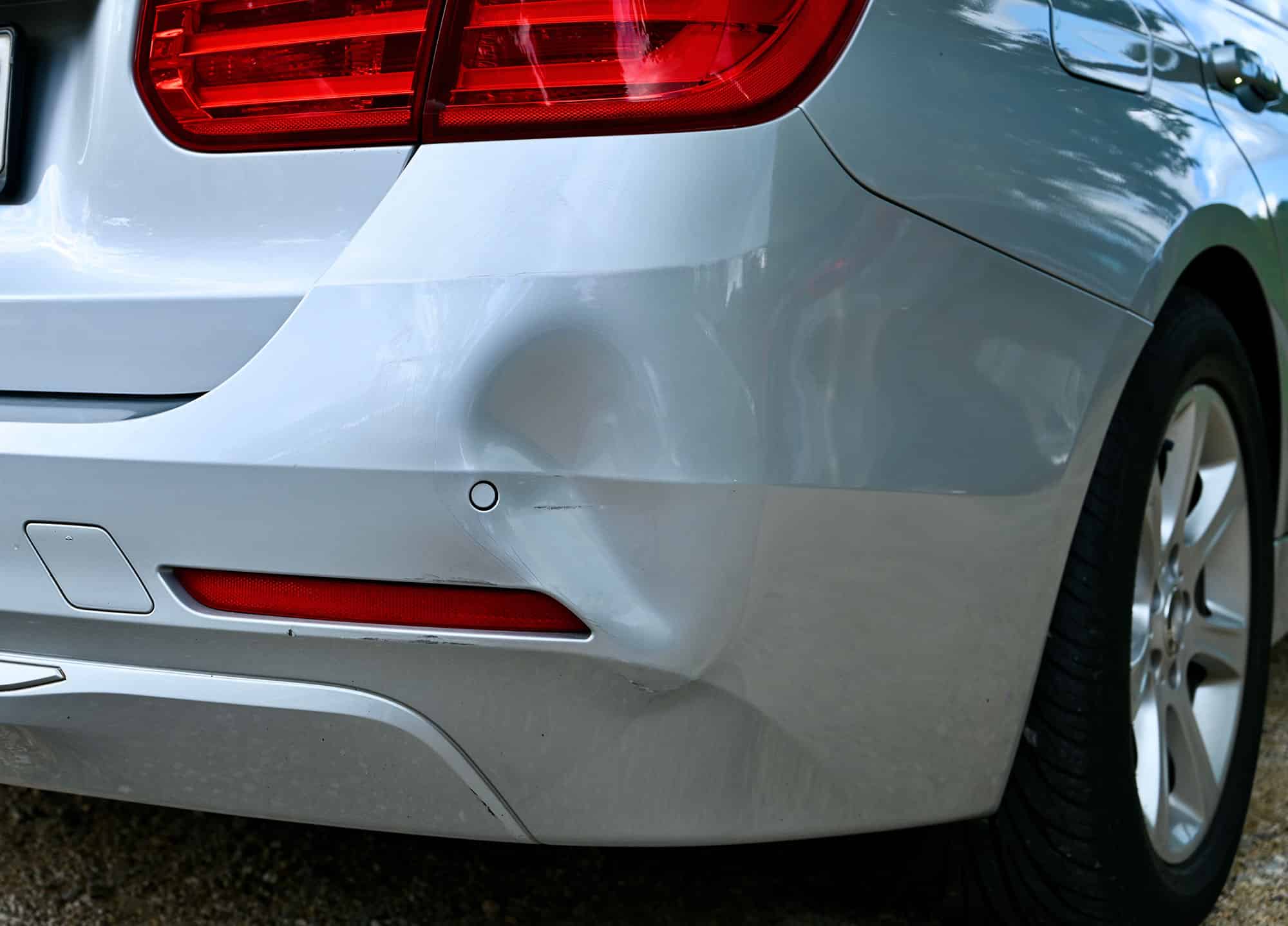
A fender repair estimate is built from six things: whether the panel is bolted on or welded in, how deep the dent goes and whether it crossed a body line, whether the panel is steel or aluminum, whether the paint has to blend into the hood or door, what’s hidden behind the panel, and where the replacement part comes from. Change any one of those and the number on the estimate moves. This page walks through each factor and shows real, dated repair examples — it does not quote AAR’s own prices or tell you what your car needs.
Repair vs. replace: bolt-on fender or welded quarter panel
The single biggest cost split on a fender estimate isn’t the dent, it’s which panel got hit.
On most vehicles, the front fender is a separate, bolted-on panel — it typically fastens to the body with bolts along the door jamb, wheel well, and under the hood, which is why a shop can often unbolt and swap it without cutting metal. The rear fender area, usually called the quarter panel, is a different animal: on most modern unibody vehicles it’s welded into the body shell as a structural piece, not a bolt-on cosmetic one. That construction difference is why a front fender repair and a "rear fender" repair aren’t the same job, and why estimates for the two can land in very different ranges even for similar-looking damage. Replacing a welded quarter panel means cutting out the old spot welds, fitting and welding in the new panel, and refinishing a much larger repair footprint than a bolt-on swap requires. If measurements show the damage went past the fender into the structure, what a frame damage repair quote includes is the next read.
| Panel | How it attaches | What that means for the estimate |
|---|---|---|
| Front fender (bolt-on) | Bolted at the jamb, wheel well, and under-hood mounts | Can often be unbolted and replaced without structural welding |
| Rear quarter panel (welded) | Spot-welded into the unibody structure on most modern vehicles | Replacement requires cutting old welds, fitting, and welding the new panel — more labor and a larger refinish area |
Whether a specific panel is repairable or needs replacement is a vehicle-specific, damage-specific call the shop makes after inspection — not something this page can decide from a description or photo. The bumper cover next to the fender is usually priced as its own line; see what a bumper repair quote includes.
Dent depth, creases, and body lines: what the shop is measuring
Before any part gets ordered, the shop is measuring the damage itself, and three things about that damage drive the repair-method decision.
A dent’s depth, whether it created a sharp crease versus a smooth low-spot, and whether it crosses a body line (the sculpted edge that runs down a fender) all change how it’s fixed. A shallow, smooth dent that doesn’t cross a body line and hasn’t stretched the metal is often a paintless dent repair candidate. A dent that creases the metal, crosses a body line, or has stretched or torn the panel typically needs conventional filler-and-paint repair or, past a certain severity, replacement. The deeper and sharper the damage, the more likely the estimate moves from "repair" to "replace."
Aluminum vs. steel: why the metal changes the estimate
What the fender is made of is its own cost driver, separate from how badly it’s dented.
Manufacturers have shifted some body panels to aluminum for weight savings, and aluminum repair isn’t interchangeable with steel repair — it requires separate tools, a dedicated work area to prevent cross-contamination with steel dust, and technicians trained specifically for it. The Insurance Institute for Highway Safety tested this directly on a 2015 Ford F-150: in matched 10 mph, 15%-overlap front and rear tests against an otherwise identical steel truck, IIHS found "total repair costs for front and rear damage combined were 26 percent higher for the aluminum F-150" than the steel model, with front-end labor running 22% higher because of extra assembly work before the aluminum fender went on. That’s one truck, one manufacturer, one test protocol — not a rule for every aluminum panel on every vehicle — but it shows the direction the material shift moves an estimate.
Paint and blending into the hood or door
A repaired or replaced fender rarely gets painted in isolation — the color and clear coat usually have to disappear into the hood on one side and the door on the other, and that’s a separate line item from the panel work itself.
Blending — feathering new color into the adjacent, undamaged panel so the eye can’t find the edge — is standard collision-industry practice for matching a repainted or replaced panel to the rest of the vehicle. Because a fender sits between two panels most drivers look at constantly, a blend that isn’t priced and matched carefully is one of the more visible mistakes an estimate can hide.
What’s hidden behind a fender
The visible dent is rarely the whole story — a fender covers or borders several parts that don’t show up until the panel comes off or gets inspected closely.
A wheel-well liner (often plastic or foam) sits just behind the fender to manage debris and water; it can crack or tear in the same impact that dents the panel. On many vehicles the headlamp housing mounts to or near the fender’s forward edge, and a side mirror mounts near its rear edge — either can be damaged in the same hit. On some vehicles, blind-spot or parking-sensor hardware is mounted to or near the fender or the adjacent quarter panel. I-CAR’s published guidance on blind-spot sensor mounting locations is direct about why this matters: "it can be crucial to have the mounting location straightened to the correct measurement," and following "these specifications and OEM procedures will help ensure a complete, safe, and quality repair." None of those items show up on a walkaround estimate the way a dent does — they surface once the shop actually opens up the repair.
How ADAS sensors change a fender repair
On vehicles with a blind-spot or parking sensor mounted to or near the fender, "repair" can mean more than metal and paint.
When a sensor is mounted to a body panel that’s straightened, repaired, or replaced, restoring the sensor to its original factory position and orientation matters as much as restoring the sheet metal’s shape — a panel that looks right but sits the sensor even slightly out of spec can leave the system reading incorrectly. Some manufacturers publish exact measurement tolerances for these mounting locations; others don’t, which is one more reason the exact requirement is vehicle-specific rather than something this page can state generally. Whether a given fender job needs a post-repair scan or calibration depends on whether a sensor was disturbed — a fact the shop determines from the vehicle, not from this page.
OEM vs. aftermarket vs. recycled fenders
Where the replacement panel comes from is a separate decision from the repair method, and it’s one an estimate should state plainly rather than bury in a parts code.
Three sourcing categories typically show up on a fender estimate: OEM (made by or for the vehicle’s manufacturer), aftermarket (made by an independent parts manufacturer to fit the same vehicle), and recycled/LKQ (a used OEM part pulled from another vehicle). The Certified Automotive Parts Association (CAPA) runs a certification program that covers metal exterior parts, including fenders, under its CAPA 101 metal-parts category; the specific ANSI/CAPA test standard currently published under that category, ANSI/CAPA 101-001-2019, covers striker retention testing for replacement sheet-metal hoods, which shows the level of independent testing CAPA applies within the metal-parts program generally. Not every aftermarket fender carries CAPA certification, and certification status is a fact to ask about, not assume.
| Source | What’s generally true | What still depends on the vehicle |
|---|---|---|
| OEM | Made to the manufacturer’s original spec and tooling | Availability, lead time, cost |
| Aftermarket, CAPA-certified | Tested under CAPA’s metal-parts (CAPA 101) certification program | Fit and finish on the specific vehicle; sensor-zone use may be restricted by the manufacturer |
| Aftermarket, non-certified | No independent comparative testing on record | Quality and fit vary by manufacturer |
| Recycled/LKQ | A used OEM part from another vehicle | Prior condition, paint match, mileage-equivalent wear |
An insurer’s preferred-parts policy, not just the shop’s recommendation, often drives which category appears on the estimate first — ask which one is being proposed and why.
Insurance claim or self-pay: what to weigh before you decide
Whether to file a claim or pay out of pocket is a math-and-risk question, not a legal one, and it’s worth working through before repairs start rather than after.
The Illinois Department of Insurance’s consumer guidance on filing with your own carrier lays out the basic mechanics plainly: your deductible is subtracted from the settlement "each time you submit a claim," you’re free to choose your own repair shop, and there’s no law capping how many estimates an insurer can require before approving repairs. It also flags that insurers treat an inflated estimate designed to help a customer recover their deductible as fraud. None of that is legal advice, and none of it says whether filing makes sense for a specific repair — that comparison is between the estimated cost and your own deductible, plus how a claim might affect renewal pricing, which varies by insurer and state.
Dated example estimates: what real fender repairs have cost
Real, sourced numbers show the range better than a made-up one. Two independent, dated examples:
| Vehicle / scope | Cost | Date / source |
|---|---|---|
| 2015 Ford F-150, aluminum body, 10 mph/15%-overlap front test — fender and related front-end damage | $4,147 (26% higher than the matched steel model’s $3,759) | IIHS aluminum-vs-steel F-150 repair cost report, published July 30, 2015 |
| Aggregate repairable estimates, all damage types, U.S. fleet | Preliminary average total cost of repair: $4,818 for 2025 (up 1.7% over 2024) | CCC Intelligent Solutions, Crash Course 2026 report |
The F-150 figures are one vehicle, one manufacturer, one test protocol, one point in time — they are not a price range for any current-year vehicle or any AAR estimate. The CCC figure is a fleet-wide repair average across all damage types, not a fender-specific number. Both are shown as dated, sourced examples of how a real estimate itemizes and totals, not as a prediction for any reader’s repair.
What can make an estimate change mid-repair
An estimate written before disassembly is a starting point, not a final number, and knowing why it moves helps you read a revised one.
Removing the fender can expose wheel-well liner, headlamp, mirror, or sensor-bracket damage that wasn’t visible from outside. A sensor thought to be reusable can test out of tolerance once the technician measures it, adding a scan or calibration line that wasn’t on the original estimate. What looked like a repairable dent can turn out to have crossed a body line or stretched the metal once the paint is sanded back, moving the job from repair to replacement. A part ordered as one sourcing category can be substituted for another if the first isn’t available in a reasonable timeframe — that substitution should come back to you before it’s made, not appear on the final invoice.
What to ask before you approve the work
You don’t need to diagnose the repair yourself. A short list of questions gets you a clearer estimate:
- Is this fender bolted on or welded in, and does that change the labor?
- Is this a repair, a refinish, or a full panel replacement — and why?
- What’s behind or beside the panel — a liner, headlamp, mirror, or sensor — and was it checked?
- Will the paint blend into the hood or door, and is that priced separately?
- Are any sensors in the repair area, and will they need scanning or calibration?
- What part category — OEM, aftermarket, or recycled — is being proposed, and is it CAPA-certified if aftermarket?
- What happens to the estimate if teardown finds more damage?
- If you’re filing a claim, how does the estimated cost compare to your deductible?
For a Rowlett-area vehicle, Accelerate’s fender repair service is the existing local owner for getting those questions answered against your actual vehicle. That link does not diagnose damage, quote a price, or promise a specific repair outcome.
The practical answer
A fender repair estimate is not one number — it’s the sum of a bolt-on-versus-welded construction call, how deep and sharp the dent is, what metal the panel is made of, whether paint has to blend into the hood or door, what’s hidden behind the panel, and where the replacement part comes from. Change any of those six factors and the total changes with it. The way to read an estimate well is to ask which of the six it’s charging for, not to compare a single total against a number you saw somewhere else.