

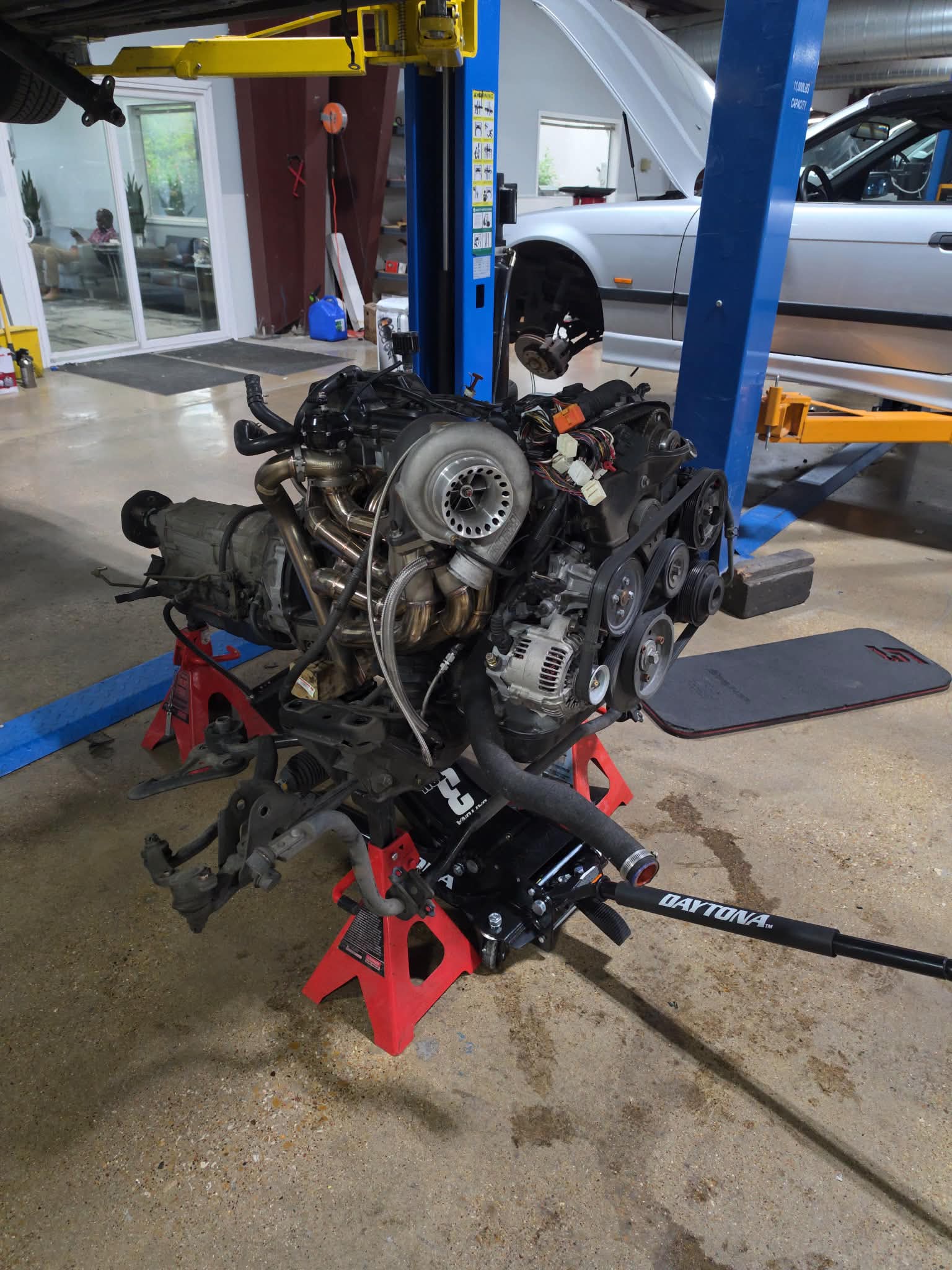
Turbo lag is the delay between a driver's demand for acceleration and the turbocharged engine's boosted response. Some delay can be a normal characteristic of the engine, turbo, gear and operating conditions.
A delay that is new, worsening or paired with a warning light, smoke, abnormal noise or reduced power is not something to dismiss as “just lag.” It needs evidence-based diagnosis.
Turbo lag and boost threshold are related, not identical
Garrett Motion explains that a turbo needs exhaust energy to accelerate its turbine and compressor. At low engine speed or low load, the engine may not yet supply enough exhaust flow for significant boost. Garrett calls the minimum engine-speed region where substantial boost begins the boost threshold.
For a useful owner conversation, keep two ideas separate:
- Boost threshold: whether current engine speed and load can support meaningful boost.
- Transient response or lag: how the system responds after the driver requests more torque under conditions where boost can build.
Drivers often call both “lag.” A vehicle below its useful boost range may feel flat without having a failed turbo. A vehicle that used to respond consistently and now does not may have a fault. The baseline matters more than the label.
What shapes normal turbo response?
Engine speed, load and gear
Garrett ties boost threshold to engine speed and available exhaust flow. Record the engine speed, selected gear and operating conditions where a complaint occurs; this article does not predict how changing gear or load should affect an unverified vehicle.
This is not an instruction to reproduce a symptom on public roads. It is a reason to record the conditions under which it happened and let a qualified technician reproduce it safely.
Turbocharger size and rotating inertia
Garrett describes response delay in terms of the turbine and compressor wheels overcoming rotational inertia, and says a larger turbo can support greater high-speed output while increasing low-speed response delay. That source does not supply a universal spool-time number.
Turbine housing and A/R
Garrett's turbine-housing guidance explains that a larger A/R can increase high-engine-speed flow capacity while shifting response away from low speed. The selected housing must match the intended power band. A/R is one variable, not a quality score where smaller or larger is always better.
Exhaust-pulse management
A correctly engineered twin-scroll system can preserve exhaust-pulse energy and improve low- and mid-speed response. That mechanism belongs to N16. It does not eliminate every source of delay or establish that a twin-scroll conversion fits another engine.
Air path, intercooler and boost control
Garrett's registered materials name air-path restriction, pipes and hoses, intercooler leaks, the wastegate and the engine-management system as categories that can affect response or belong in system diagnosis. This article does not turn those categories into a universal test sequence or control-system specification.
Observation log: characteristic or new fault remains an open question
Use a before-and-after baseline instead of deciding from one sensation.
| Observation | What to record | What the record does not prove |
|---|---|---|
| Delay has behaved the same since the vehicle was acquired | The repeated engine-speed, gear and operating context | That the behavior is manufacturer-defined as normal |
| Delay began suddenly or changed gradually | When the change was first noticed and how it has progressed | Which component or system caused the change |
| Warning light or reduced-power message appeared | The exact message and any codes retrieved through the applicable service path | That one code identifies one failed part |
| Smoke, oil loss or a new abnormal noise appeared | The exact observation and when it occurs, without trying to force it | That the turbocharger is the source |
| Response changed after service, software work or a modification | The exact before-and-after configuration and date | That the most recent change caused the complaint |
| Temperature, altitude or fuel differed | The observed condition and fuel information available to the driver | That the difference makes the response normal or abnormal |
The worksheet does not classify a vehicle as normal or faulty. It preserves observations so the applicable manufacturer path can begin with a defined complaint rather than the label “turbo lag.”
Why a slow response does not automatically mean a bad turbo
Garrett's system-diagnostics guidance begins with a stop-before-replacement rule: turbo damage can be a symptom of an underlying problem rather than its cause. For lack of power, it directs attention to air filters, hoses and pipes, fuel injection, and exhaust restrictions before assuming the turbo is the failed part. For noise, it includes pipework, supports, connections and intercooler leaks. Oil consumption and smoke add oil specification, drain restriction, crankcase pressure, breathers and hose condition.
Those are diagnostic categories, not a checklist for the owner to perform. Their value is that they widen the evidence set before an expensive component is condemned.
A Ford bulletin supplies one application-limited example. Some 2024 F-150 Lariat, XLT and XL vehicles equipped with the 3.5-liter PowerBoost engine may exhibit right-side turbo overspeed, turbo damage and listed symptoms including reduced acceleration or P0299:00. Ford says this may be due to an upper air deflector deforming and restricting turbo intake air. The bulletin applies only when its complete vehicle and symptom criteria are met; the symptom or code alone is not a universal “replace the turbo” instruction.
A 2026 GM bulletin gives another bounded example for North American 2023–2026 Chevrolet Equinox and GMC Terrain vehicles with the 1.5-liter LSD engine and reduced power with DTC P0237, P0101, P1101, P0234 or P0299. It assigns different professional diagnostic branches to different code combinations: P0234 alone includes wastegate-control checks; P0237 potentially combined with P0101/P1101 includes a charge-air-cooler inlet-hose branch; and P0299 potentially combined with P1101 includes a separate hose branch. P1101 alone is outside this bulletin's repair resolution, while P0299 alone routes to bulletin 25-NA-227 for its fuel-level concern or standard service-information diagnosis. This does not diagnose an unlisted vehicle or collapse those branches into one checklist.
A source-bounded evidence ladder for a new delay
Move from observation to measurement before moving to parts.
| Evidence level | Record or professional path | Decision value and limit |
|---|---|---|
| 1. Driver observation | When the change began; exact warning, smoke or noise; and the safely observed engine-speed, gear and operating context | Defines the complaint without naming a cause |
| 2. Configuration history | Exact service, software or hardware change and date | Preserves the before-and-after state without assigning causality |
| 3. Applicable vehicle information | Retrieved codes and the exact manufacturer diagnostic path selected for that vehicle | One code does not select one part |
| 4. Registered system categories | Garrett's air-filter, pipe/hose, fuel-injection, exhaust, intercooler, oil/drain, crankcase/breather and turbo-damage categories under the applicable professional procedure | These categories are not an owner checklist or a finding |
| 5. Vehicle-specific branch | A Ford, GM or other manufacturer branch only when its complete model, configuration, symptom and code conditions match | A bulletin example does not diagnose an unlisted vehicle |
No single observation or generic code closes this source-bounded path.
What can make turbo response feel slower?
A restricted intake or exhaust
Garrett's system-diagnostics page includes a dirty air cleaner and a blocked exhaust system among its lack-of-power categories. The exact vehicle's professional diagnostic procedure determines whether either category applies and how it is tested.
A charge-air leak
Garrett's diagnostic categories include loose connections, cracked or leaking pipes and hoses, and intercooler leaks. Those categories do not identify a leak on a particular vehicle; use its specified professional test process.
Wastegate or actuator control
Garrett identifies the wastegate as a response factor. The GM bulletin above provides narrower wastegate-hose, solenoid, actuator and lever branches only for its specified vehicles and code conditions. Outside that applicability, “wastegate problem” remains an unsupported label until the exact manufacturer path is followed.
Sensor or engine-management input
Garrett identifies the engine-management system as one response factor. This article does not infer a failed sensor, module or calibration from a sluggish-response complaint.
Lubrication, contamination or heat damage
Garrett identifies foreign objects, lack of lubrication, oil contamination, overspeed and excessive temperature among turbo-damage categories. If the turbo is damaged, the cause must be addressed before replacement or the next unit can face the same condition.
What not to do in the name of reducing lag
- A generic promise does not establish that a smaller turbo, twin-scroll housing or tune fits the vehicle or goal.
- This article does not prescribe raising boost, bypassing a warning, or reproducing a complaint on public roads.
- One underboost code does not establish that the turbocharger should be replaced without the applicable manufacturer path.
- Motorsport control strategies are outside this article's repair scope.
Changing an expected response characteristic and diagnosing a newly changed response are different questions. This article does not provide the design, calibration or risk analysis for the first, or a universal diagnostic procedure for the second.
Questions to bring to the diagnosis
- Is the delay new, worsening or unchanged since the vehicle was acquired?
- What exact gear, engine speed, load, temperature and weather were present?
- Did a warning light, reduced-power message, smoke, oil loss or abnormal noise appear?
- What service, software, fuel or performance change preceded the complaint?
- What codes and freeze-frame conditions were stored?
- What were requested and actual boost or load values under the approved test?
- Were the intake, charge-air system, intercooler and exhaust checked for restriction or leakage?
- Were wastegate command, actuator response and related plumbing tested?
- Does the exact vehicle have a manufacturer bulletin or known diagnostic branch that applies by VIN and configuration?
- If turbo damage is confirmed, what underlying cause was identified?
- What must be cleaned, repaired or replaced before a new turbo is installed?
- How will the repair be validated without simply clearing a code?
When to stop treating it as normal lag
A new response delay with smoke, oil loss, abnormal turbo noise, a warning light or a reduced-power message is outside a sensation-only comparison. Follow any instruction displayed by the vehicle and the exact owner's manual. Otherwise, obtain vehicle-specific professional or roadside direction rather than using this article to decide whether or how to drive it.
This article cannot decide whether a specific vehicle is safe to drive.
The practical answer
Some turbo lag is an expected delay while exhaust energy and rotating speed build. What counts as normal depends on the exact engine, turbo, calibration, gear, load and conditions.
When the delay changes, preserve the baseline and retrieve the applicable manufacturer path before treating the turbocharger as the failed part. For a Rowlett-area vehicle, Accelerate's turbo installation and replacement service is the relevant existing owner for a repair, replacement or properly scoped build.