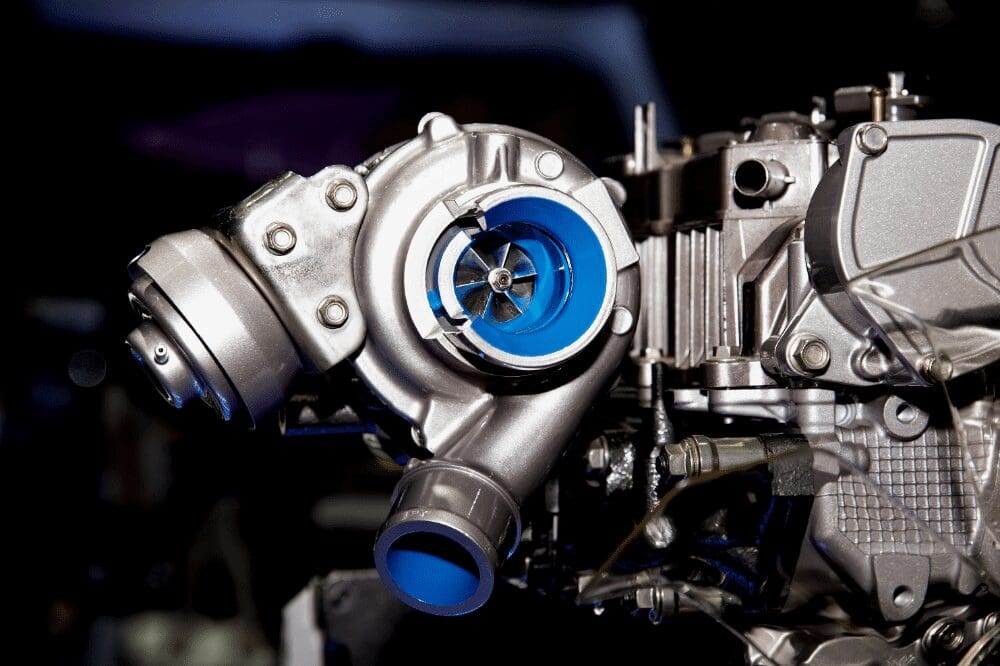

People come to us for a turbo for two different reasons, and they are not the same job.
Either your factory turbo failed and the car needs to run right again, or you want boost the car never came with. The first is a repair with a root cause that has to be found. The second is a build that has to be supported by fuel, cooling, and a tune. We do both, on gas and diesel.
Turbo Replacement: When the Factory Turbo Fails
A turbo spins to well over 100,000 rpm on a film of engine oil. Almost everything that kills one traces back to that oil, or to something that went through the wheel.
What a failing turbo actually feels like
- Power that falls off and will not build the way it used to, often with the check engine light on and a boost-pressure or underboost code stored.
- A siren or whistle that rises with engine speed and did not used to be there. That is usually wheel-to-housing contact or a failing bearing.
- Blue or grey smoke, especially on start-up or after idling, plus oil disappearing with no puddle on the driveway. That is oil past the turbo seals into the intake or the exhaust.
- Oil in the intercooler piping. Pull a coupler and look. A wet, oily boot is a seal telling you it is done.
- Shaft play. With the intake off, the wheel should spin freely and should not move meaningfully toward the housing.
Why the cause matters more than the part
This is the part that decides whether you buy one turbo or two. If the bearing failed because the oil feed line was restricted, or the oil was long past its interval, or coolant got into the oil, then a new turbo bolted onto the same problem fails the same way. We find the cause first, and that is a diagnostic job, not a parts-swap.
When a turbo goes, it also sends debris downstream. The intercooler and its piping get checked and cleaned rather than assumed clean, because metal or oil left in there goes straight back through the new unit.
Before diagnosing a heat-related problem, review how the intercooler differs from the radiator.
For divided-housing context, review how a twin-scroll turbo manages exhaust pulses.
For response-versus-fault context, review when turbo lag points to a new fault.
Replace, remanufactured, or rebuild?
All three are real options and the right one depends on the vehicle and on what you plan to do with it. What does not change: the oil feed and drain lines get attention, and the engine gets fresh oil and a filter before the new unit ever sees load. Priming matters. A dry start on a new turbo is a short story with a bad ending.
What turbo replacement costs
Replacing a failed factory turbocharger starts around $1,500 in parts and labor, and the spread from there is wide because it is driven almost entirely by the vehicle. A Hyundai turbo might be roughly $2,000 out the door. A Mercedes turbo can reach $7,000. Make, model, and whether you go OE or aftermarket decide it.
A turbo replacement here normally also includes the engine oil, oil filter, air filter, exhaust gaskets, and the o-rings for the oil cooler and coolant lines. Those are not upsells. Reusing them is how the second turbo fails as fast as the first.
Adding a Turbo to an Engine That Never Had One
A turbo kit is not the expensive part of a turbo build. The supporting work is, and skipping it is how people end up with a fast car that lasts one summer.
- Fuel. More air needs more fuel. Injectors and pump capacity get sized to the target, not hoped at.
- Oil supply and drain. The feed has to be clean and restricted correctly; the drain has to fall the whole way back to the pan. A drain that runs uphill anywhere backs oil into the seals.
- Heat. Compressed air is hot air. Intercooling, and where that core actually sits relative to the radiator and condenser, decides whether the setup survives a Texas August.
- Boost control. A wastegate and a controller that actually holds the target, rather than a spring and optimism.
- The tune. Not optional, and not last. An untuned turbo build is the single fastest way to hurt an engine. See EFI system upgrades.
If you are still deciding between forced-induction routes, a supercharger behaves differently down low and may suit the car better. And if the goal is a healthy gain without the complexity, bolt-on modifications get further than people expect.
What a turbo build costs
Adding a turbocharger to a naturally aspirated engine, or upgrading a factory one, done properly: $5,000 to $10,000 out the door. Most engines that end up turbocharged were never designed for it, so the spread is genuinely wide and depends on the application.
That number covers the supporting work, not just the kit: fueling, the fabrication a given application needs, and the tune.
We do not tune in house. We bring in a tuner through vendors we work with, so it gets done as part of the build rather than left to you to organise afterward.

Diesel turbos are their own thing
Modern diesels mostly run variable-geometry turbos, and the vanes stick with soot long before the bearing is worn out. A truck that feels lazy and throws an underboost code does not always need a turbo. Sometimes it needs the vanes freed and the actuator checked. We look before we sell you a part. More on diesel repair.
Who Does the Work
ASE Master Certified and ASE-certified technicians. AAA Approved Auto Repair. NAPA AutoCare. Mechanical repairs carry our standard 2-year / 24,000-mile warranty.
Turbo work sits between performance and mechanical, which is the reason it lives in the speed shop but gets the same diagnostic discipline as any engine repair. A boost leak found on a smoke test is cheaper than a turbo you did not need.
Talk to Us Before You Buy the Part
Bring us the symptom or the goal and we will tell you what the job actually involves. If your turbo is failing, the sooner it is off the car the less goes downstream with it.
Accelerate Auto Repair and Collision, 3002 Century Dr, Rowlett, TX 75088. (469) 501-5115. Monday through Friday 7:00 AM to 6:00 PM, Saturday 8:00 AM to 5:00 PM, with the last hour Saturday reserved for drop-off.
Make your appointment: