
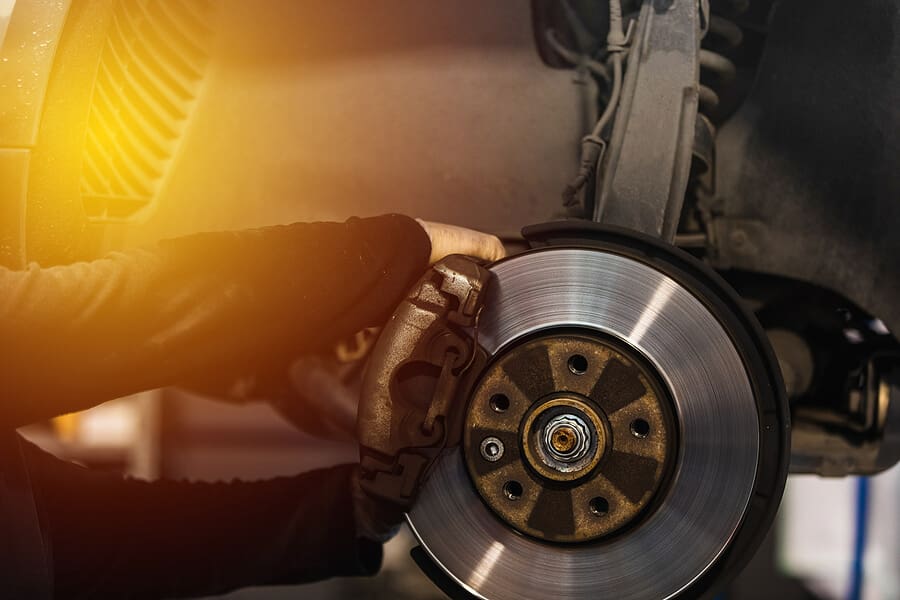
If your car shakes when you brake, the first thing that matters isn’t the part, it’s where you feel it and when it happens. A shake that only shows up the moment you press the pedal points somewhere different than a shake that’s there whether you’re braking or not. Getting that distinction right before a shop starts replacing parts is the difference between fixing the actual problem and paying for a guess.
Where you feel it points to what’s causing it
The location of the shake is a diagnostic clue, not a formality. Delphi’s technical guidance on brake judder describes how the pulsing travels: when a front rotor has an uneven thickness, "the pad to effectively bounce, creating pulses that are transmitted through the caliper pistons, via the brake fluid…to the steering wheel," and the same mechanism sends pulses "via the brake fluid to the brake pedal." Which one you feel depends on which axle has the problem, since the front wheels tie directly into the steering column and the rear wheels don’t.
| Where you feel it | When it happens | What it tends to point toward |
|---|---|---|
| Steering wheel | Only while braking | Front rotor, front caliper, or front wheel bearing |
| Pedal, seat, or floor | Only while braking | Rear rotor or rear caliper |
| Steering wheel or whole car | At speed, whether or not you’re braking | Not a brake problem; see tire and suspension causes below |
That last row is the one people miss. If the shake is there with your foot off the pedal, especially as you speed up, the brakes probably aren’t the issue at all.
The brake-side causes
A rotor that’s worn unevenly is the most common brake-side cause, but it isn’t the only one. Delphi’s guidance calls the uneven-thickness condition disc thickness variation, stating plainly that "DTV is the term used to denote a variation in thickness, meaning that these faces are no longer parallel." That unevenness, not a rotor bending out of shape from heat, is what makes the pad bounce and send pulses back through the system.
DTV doesn’t need much to get started. Delphi notes that "a single spec of rust measuring only 0.05mm in diameter, the size of a human hair, can cause axial runout of over 0.1mm when measured at the centre of the braking surface" if it’s sitting at the hub-to-disc mounting surface. Overheating the discs is another path in: Delphi states that "disc temperatures may exceed 650°C and change the structure of the disc, resulting in DTV." A caliper that won’t fully let go of the disc is a third: Delphi describes how a seized caliper can "prevent the caliper housing from moving, holding the pads against the disc even when the brakes aren’t applied," which wears the rotor unevenly over time.
Calipers cause their own symptoms even without wearing a rotor first. YourMechanic’s guidance on failing calipers describes stuck slide pins from "the buildup of dirt and grime," noting that when they jam, "the brakes will feel spongy when engaged and the caliper will not be able to fully clamp down." A seized piston is a different failure inside the same part: it "will not be able to automatically retract, which will cause a constant drag onto that wheel," and YourMechanic notes that drag can pull the car toward the affected side because "the wheel on that side is traveling slower than the wheel on the opposite side due to the brake drag." A dragging caliper will keep re-wearing a brand-new rotor if it isn’t checked and fixed at the same time as any rotor work. If the car also pulls or a wheel runs hot, see the signs of a sticking brake caliper.
A worn wheel bearing can also produce judder that has nothing to do with pad or rotor condition. A bearing this worn also tends to announce itself before it shakes the brakes, with a roaring, metal-on-metal sound tied to road speed, not brake pressure. The mechanism is covered in full in Accelerate’s steering wheel shake guide.
One more brake-side cause is mechanical, not a worn part at all. Delphi warns that "excessive torque on the wheel fasteners could lead to a warped disc hat," meaning lug nuts torqued too tight, or in the wrong pattern, can distort a thin-hat rotor on their own.
When it’s not the brakes: tires and suspension
If the shake shows up at speed with your foot off the pedal, look at the wheels and suspension before the brakes. AA1Car’s technical writeup on tire vibration is specific about the pattern: "tire/wheel balance problems will typically produce vibrations that are proportional to speed. In other words, the vibration will get progressively worse as the speed increases," and it "usually starts at 40 to 50 mph and increases in intensity as the speed goes up." AA1Car names the usual causes as "improperly balancing the tires when they were installed or mounted, loss of a wheel weight, uneven tread wear on a tire, or a tire or wheel manufacturing defect."
Uneven tread wear is worth catching early, since it can both cause and result from an imbalance problem. Staying current on rotation is one of the more straightforward ways to keep wear even across all four tires; Accelerate’s tire rotation cost guide covers what that service actually includes.
Alignment is a separate system from balance, but the two get confused often enough that it’s worth naming the difference. Misalignment doesn’t typically cause a speed-proportional shake the way an out-of-balance wheel does; it shows up more as pulling to one side, uneven tire wear over time, or a steering wheel that isn’t centered when driving straight. If a shop suspects alignment is part of what’s going on, worth knowing what that service costs on its own: Accelerate’s wheel alignment cost guide breaks down what’s included.
Worn suspension components round out the non-brake causes, and they have their own telltale timing. A worn tie rod end produces general steering looseness rather than a brake-only shake, present whenever you’re turning. Worn control-arm bushings or ball joints behave almost the opposite of brake judder, easing at speed rather than tied to the pedal.
If your symptom is specifically a pulsing steering wheel every time you brake, and you want the full mechanism-level breakdown, including how a shop measures rotor thickness and runout, Accelerate’s steering wheel shake guide walks through that diagnostic process in detail.
Is it safe to keep driving
A shake when braking is a reason to get the vehicle checked, not necessarily a reason to pull over immediately, but it isn’t something to put off either. The mechanisms behind it, a dragging caliper, a bearing with excessive play, or a rotor thin enough to lose its ability to shed heat, tend to get worse with continued driving rather than resolve on their own. A shake that’s new, that’s getting stronger, or that shows up alongside a longer stopping distance, a soft or sinking pedal, or a burning smell is a reason to have it looked at sooner rather than working it into your schedule. No source used in this piece supports a specific mileage or time window for how long it’s safe to keep driving with any one of these symptoms; that call depends on what a shop finds once the vehicle is actually inspected.
What a shop checks before naming the part
A shop that jumps straight to "you need new rotors" from the shake alone hasn’t confirmed anything yet. Delphi’s own diagnostic sequence for suspected DTV starts with measurement, not a guess from feel: technicians "measure the discs thickness, 2.5mm from the outer edge, at eight equidistant points around its perimeter," and check runout with a dial indicator, since Delphi cites "less than 0.05 to 0.10mm" as a reasonable target for maximum runout. Alongside that, a real diagnosis rules in or out the mounting surface (debris or rust), the caliper’s slide action, wheel bearing play, and wheel-fastener torque, since any of those can produce the same shake a worn rotor would.
Where you feel it and when it happens are both part of that same process. A shop that never asks whether the shake is brake-only or speed-only, or whether it’s in the wheel versus the seat, is skipping information that narrows the cause before a single part comes off the car.
What repairs like this typically cost
These are dated figures from RepairPal and YourMechanic, not Accelerate’s own pricing, and not a promise about what any specific vehicle will cost.
| Repair | Total cost range | Source | Date |
|---|---|---|---|
| Brake pad replacement, national average | $335-$394 (labor $122-$179, parts $213-$215) | RepairPal | Sept. 3, 2026 |
| Brake rotor replacement, national average | $574-$698 | RepairPal | Sept. 3, 2026 |
| Brake caliper replacement, national average | $898-$968 | RepairPal | Sept. 3, 2026 |
| Wheel bearing replacement, national average | $346-$504 (labor $226-$331, parts $121-$172) | RepairPal | Sept. 3, 2026 |
| Wheel alignment, national average | $186-$273 (labor) | RepairPal | Sept. 3, 2026 |
How much either job costs swings widely by make and model. Accelerate’s steering wheel shake guide breaks out per-vehicle pad and rotor examples if you want to see the range. YourMechanic also notes that rotors are usually replaced alongside pads: "unless brake pads were replaced recently, pads must be replaced while replacing the rotors."
If the shaking turns out to be worn pads rather than rotors, RepairPal’s national average for pad replacement is $335-$394. See what brake pad replacement costs for what that covers.
No source used here prices a tie rod end, control arm bushing, or ball joint replacement, or a standalone wheel-balancing service, so none of those figures are published in this piece.
What to ask before you approve the repair
- Where do you feel the shake, wheel, pedal, or seat, and does that match the part being quoted?
- Does the shake happen only while braking, or also at speed with your foot off the pedal?
- Was rotor thickness and runout actually measured, or was the rotor condemned from the shake alone?
- Was the caliper’s slide action checked, so a dragging caliper doesn’t recreate the same wear on a new rotor?
- Were wheel bearing play, tie rod play, and alignment checked before this was quoted as a rotor or pad job?
A shop that can answer all five has traced the shake to where it’s actually coming from, not just replaced the part that’s easiest to blame.
None of this is a claim that any specific vehicle needs new rotors, pads, a caliper, or a bearing. A shake when braking can trace to several points across the brake, wheel, and suspension systems, and a real diagnosis finds the one actually at fault before a part gets replaced.
For a Rowlett-area vehicle with a shake, pulse, or vibration when braking, Accelerate’s brake repair service is the existing local owner for tracing the cause before any part is replaced. That link is not a claim that any specific repair is priced or guaranteed there.